
Summary
Agentic artificial intelligence fundamentally transforms complex financial workflows by shifting invoice processing from static rules to dynamic autonomous orchestration.
Transitioning from isolated task automation to multiagent orchestration mitigates fragmented system bottlenecks and accelerates business cycles.
Intelligent document processing captures, extracts and validates unstructured invoice data without requiring rigid machine learning templates.
Autonomous exception handling and proactive fraud detection reduce organizational risk while redirecting human talent toward strategic financial planning.
How is the evolution of finance moving beyond traditional AP automation?
Enterprise financial evolution requires intelligent agents that move beyond static workflows to execute dynamic reasoning. Traditional accounts payable (AP) automation relies on rigid systems that falter under variability; agentic AI introduces contextual decision-making to orchestrate complex operations seamlessly.
Transitioning from rigid rules to autonomous reasoning
Legacy automation systems depend heavily on hard-coded templates and static logic trees. These traditional frameworks often break down when encountering unstructured data or unexpected vendor formats. Agentic automation solves this challenge by deploying specialized AI agents that collaborate to complete complex financial workflows autonomously.
The advanced reasoning capabilities allow an accounts payable AI agent to parse context, validate discrepancies and make dynamic routing decisions without constant human intervention.
> Read more | Maximizing value from unstructured data
The mandate to eliminate manual AP workflows
Growing invoice volumes and diverse vendor formats quickly overwhelm human operators and legacy capture systems. Organizations find that eliminating manual AP workflows is essential for reducing costly data entry errors and accelerating financial close cycles. Automating repetitive tasks frees financial professionals to focus on higher-value analysis and supplier relationship management.
Industry research underscores this transformation. Gartner reports a 1,445% surge in client inquiries regarding multiagent systems designed to complete complex workflows.

Harvard Business Review Analytic Services pulse survey insights
Going beyond traditional AI and toward agentic AI
Many organizations find themselves unprepared to harness the full potential of AI. This pulse survey from Harvard Business Review Analytic Services reveals that while 94% of leaders recognize the importance of well-connected data for AI success, only 27% have achieved it.
What are the core use cases for AI agent implementation in AP processes?
Enterprise finance teams apply intelligent AI agents to handle dynamic data capture, autonomous exception routing, complex invoice matching and proactive fraud detection. These coordinated agentic capabilities accelerate end-to-end invoice life cycles while maintaining strict governance over critical transactions.
> Read more | Understand the potential of AI agents
Applying intelligent capture and invoice coding
The standard AI agent implementation in AP processes begins with capturing unstructured invoice data directly from emails, vendor portals and physical scans. Zero-shot classification, in which AI uses its general understanding to categorize data without being specifically trained on those categories, eliminates the need for extensive machine learning training to extract relevant line-item data. This means AI-driven invoice coding automatically maps extracted data to the proper general ledger accounts based on historical context.
Orchestrating autonomous exception handling
Multiagent systems continuously identify discrepancies between invoices, purchase orders and receiving documents. When data is missing or mismatched, these agents autonomously query external systems or vendor portals to resolve the information gap. Human-in-the-loop oversight is triggered only when discrepancies fall outside predefined confidence thresholds.
Integrating proactive fraud detection protocols
Security remains paramount in financial operations. AP automation providers utilize AI agents to securely cross-reference vendor details against established databases. This agentic capability easily identifies duplicate invoices, anomalous billing amounts and altered payment routing instructions. These autonomous checks mitigate financial risk before payments are authorized.
Streamlining financial close and reconciliation
Continuous automated invoice processing prevents end-of-month accounting backlogs that frustrate finance departments. AI agents perform real-time financial reconciliations across fragmented ERP platforms to maintain a single source of truth. Clean, validated data flows directly into financial planning and analysis models for improved forecasting and strategy.
> Read more | Streamline automation by embedding agentic AI workflows
Baptist Health processes 4,000 non-purchase-order invoices autonomously
Baptist Health automated the processing of 4,000 non-purchase-order invoices through intelligent document processing. This automation saved the health system 67 hours per month in administrative processing. By streamlining these repetitive tasks, the organization freed staff to transition from manual data entry to working on strategic financial projects.
What are the key benefits and ROI of agentic AI for accounts payable?
Modern organizations deploying agentic AI for AP capture measurable advantages by achieving accelerated processing speeds, optimized cash flow management, reduced transaction costs and greater data precision, while easily scaling operational capacity without adding new employee headcount.
Accelerating operational speed and cash optimization
Autonomous routing reduces the average invoice processing time from weeks to minutes. Faster processing cycles empower organizations to consistently capture early payment discounts that compound over time. Real-time data visibility fundamentally improves cash flow optimization and working capital management for enterprise financial leaders.
> Read more | The ROI of AP automation
Driving cost efficiency and organizational scalability
Eliminating manual touches drastically lowers the per-invoice processing cost across the board. Agentic systems absorb seasonal invoice spikes without requiring temporary staffing or overtime pay. Scalable AI frameworks allow enterprises to expand operations or acquire new business units without proportional overhead increases.
Improving error reduction and data precision
Intelligent extraction minimizes human transcription errors during the initial invoice capture phase. Continuous algorithmic validation results in greater precision across all financial records and general ledgers. Reducing errors upstream prevents costly downstream rework and avoids complex vendor payment disputes.
Redirecting talent toward strategic value creation
Forward-thinking leaders frame automation not as employee replacement but as an essential tool for unburdening staff from repetitive data entry. Financial professionals pivot their focus to exception management, complex vendor negotiations and advanced financial modeling. Improving the employee experience through modern tools directly correlates with higher talent retention.
Investing in artificial intelligence for growth, efficiency and competitiveness isn't a leap of faith anymore, but a strategic necessity for businesses.
Sharp Healthcare achieves a 26% reduction in staffing requirements for manual tasks
Sharp Healthcare enabled a 26% reduction in staffing requirements for manual financial processing tasks. The organization sped batch processing cycles from hours down to minutes using AP intelligent document processing automation. This shift increased overall processing capacity and improved the ability of the organization to secure early payment discounts consistently.
How can organizations overcome industry challenges with enterprise AI agents?
Enterprise financial leaders deploying AI agents must address critical technical barriers directly to drive success by overcoming fragmented data silos, establishing comprehensive audit trails and integrating human-in-the-loop oversight to maintain strict compliance across the entire financial ecosystem.
Bridging the auditability gap in autonomous systems
Many business leaders express concern that AI agents operate as unobservable black boxes during critical financial decision-making. Enterprise-grade systems automatically generate digital system logs and predefined compliance reports for every autonomous action taken. Maintaining transparent evidence trails is a fundamental necessity for internal auditors and external regulatory bodies.
> Read more | Understanding audit trails: Types and benefits
Maintaining data integrity across legacy ERPs
Deploying modern AI tools across disparate legacy enterprise resource planning platforms presents a significant architectural challenge. Organizations rely on REST APIs and prebuilt connectors that allow AI agents to securely query and update systems of record. Bridging these data silos prevents information fragmentation and establishes that agents operate using a single source of truth.
> Read more | Overcoming data silos
Implementing human-in-the-loop oversight frameworks
Agentic automation doesn’t remove human control from critical financial decisions. Organizations configure specific confidence thresholds that automatically route ambiguous invoices to human specialists for review. The agents summarize context and suggest next-best actions to accelerate human review when oversight is required.
Data reveals that 54% of CEOs expect technology investments to help mitigate risk. Providing this transparent human-in-the-loop control is central to mitigating that risk effectively.
Guidelines on how to choose an AI agent for accounts payable
Evaluating the scalability and security of an AI agent for AP dictates long-term success. Business users require point-and-click configuration tools that allow them to manage agents without heavy IT reliance. Experts recommend prioritizing platforms that offer native integration with existing enterprise content management infrastructures.

Forrester study: Unlocking the full potential of AI agents
Enterprise-wide AI agent adoption is accelerating
In this Hyland-commissioned study by Forrester Consulting, Forrester found that more than 45% of organizations already use AI agents and another 25% are piloting them. Although adoption is accelerating, most organizations struggle to scale beyond early use cases due to a lack of enterprise context.
Forrester provides key recommendations for how to get AI agents right, as well as detailed data on enterprise trends around agent use. Download this report to learn more about how organizations are looking to AI agents to optimize workflows, make smarter decisions and create more personalized experiences.
How should enterprises evaluate AP automation providers?
Technology selection requires evaluating specific architectural capabilities that drive long-term autonomous value by prioritizing AP automation providers offering native enterprise orchestration, zero-shot processing models, robust system integrations and scalable multiagent deployment frameworks designed specifically for demanding financial operations.
Assessing zero-shot classification and extraction capabilities
Enterprises must evaluate AI agents based on large language model capabilities. The operational advantage of zero-shot processing over legacy optical character recognition is significant since it doesn’t require rigid templates. Native natural language processing allows systems to dynamically adapt to unexpected invoice layouts.
> Read more | What is intelligent document processing?
Rexel Canada achieves near-perfect invoice accuracy
Rexel Canada reached nearly 100% invoice ingestion accuracy within 48 hours of deploying Hyland’s agentic intelligent document processing. By eliminating manual invoice validation for non‑trade AP, Rexel significantly reduced processing times, increased efficiency and established a scalable foundation for autonomous, AI‑driven financial operations aligned to its Axelerate 2028 strategy.
Evaluating enterprise system integration depth
Selecting providers that offer an API-first architecture and prebuilt integration templates accelerates deployment timelines. Seamless integration with systems such as Workday, SAP and core banking platforms drives immediate time to value. Orchestration engines capable of coordinating multiple AI agents alongside existing robotic process automation investments are a definitive requirement.
Verifying security and governance protocols
Financial operations mandate specific security certifications, including SOC 2, ISO 27001 and NIST frameworks. Enterprise providers must offer per-document encryption, granular role-based access controls and zero-trust permissions to protect information. Automated content life cycle management protects sensitive financial data from ingestion through defensible disposition.
What are the best practices for AI agents in AP enterprise environments?
Implementation methodologies for enterprise deployment of AI agents require structured approaches to maximize autonomous business value by mapping existing processes, defining clear operational thresholds, integrating continuous monitoring mechanisms and establishing robust data governance frameworks to optimize these advanced platforms.
Mapping end-to-end financial workflows for agentic orchestration
Auditing current AP processes is a prerequisite to identify specific bottlenecks, data silos and manual handoffs. Mapping workflows allows organizations to efficiently apply the right automation technology to the right task. Industry experts driving best practices recommend starting with high-volume standardized invoices before scaling.
> Read more | What are agentic AI workflows?
Defining confidence thresholds for autonomous decisioning
Business leaders must establish rigid parameters dictating when an AI agent can act autonomously vs. requiring supervision. Calibrating these thresholds during initial deployment balances processing speed with risk mitigation. Clear guardrails prevent unauthorized payments and maintain strict adherence to internal financial policies.
Establishing continuous monitoring and iterative improvement loops
Self-service reporting dashboards are essential to monitor agent performance, processing volumes and exception rates. Analyzing exception data allows organizations to continuously refine agent prompts and update institutional knowledge bases. Treating agentic automation as an iterative life cycle rather than a one-time deployment yields greater long-term return on investment.
Learn how Redstone Federal Credit Union saved 2,000 hours per year in manual processing effort
Redstone Federal Credit Union implemented workflow automation and robotic process automation to streamline repetitive financial processes. These technologies saved the organization 2,000 hours per year in manual processing effort. The institution achieved a cumulative annual wait-time reduction of 33,557 business days across operations.

Subscribe to The Shift
Hyland’s monthly newsletter helps you elevate your content management strategy
Offering unparalleled insights into the AI and cloud technologies transforming what content can do, The Shift gives you actionable strategies from industry thought leaders. Learn from real-world success stories and innovative perspectives that will keep your organization at the forefront of ECM transformation.
Subscribe to stay ahead, stay informed and make your enterprise content an even more strategic asset.
What does the autonomous future of financial operations look like?
Integration of agentic AI into accounts payable signifies a fundamental shift in enterprise financial management where organizations adopting these autonomous frameworks achieve unprecedented scalability, improved precision and a sustainable competitive advantage that transforms modern operations into strategic growth engines.
Transitioning to strategic financial orchestration
Moving beyond basic task automation to multiagent orchestration fundamentally redefines the role of the accounts payable department. Eliminating manual data entry drives immediate cost reductions while generating richer real-time financial insights for the business. Organizations failing to adopt agentic automation will struggle to compete regarding operational agility and working capital optimization.
Expanding agentic capabilities across the broader enterprise
Successfully deploying AI agents within AP serves as a blueprint for transforming adjacent departments like human resources and legal. Unifying content and process intelligence across the organization drives compounding operational value. The Hyland Content Innovation Cloud™ provides the secure scalable foundation required to orchestrate these enterprise-wide autonomous transformations.
Begin your intelligent journey
Hyland delivers the foundational architecture required to orchestrate end-to-end process automation across the modern enterprise.
Hyland Content Innovation Cloud brings together content, process and intelligence to enable organizations to build sophisticated multiagent workflows.
Hyland IDP™ delivers AI-native agentic document processing that enables transformational automation for content-dependent processes.
Through Hyland Agent Builder™, organizations configure AI agents to make autonomous decisions within secure thresholds while maintaining human-in-the-loop control.
These capabilities are orchestrated by the AI-enabled Hyland Automate™, which provides a prompt-based design studio and prebuilt connectors for seamless integration.
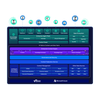
Content Innovation Cloud
The platform to power content innovation
Content Innovation Cloud is the future of enterprise content management. By leveraging a unified content, process and application intelligence platform, your organization can unlock profound insights from enterprise content and unstructured data — fueling innovation without disruption.
What is an AI agent in accounts payable?
An accounts payable AI agent is an autonomous program that uses advanced reasoning to parse context, validate discrepancies and make dynamic routing decisions without constant human intervention.
How does agentic AI differ from traditional AP automation?
Traditional AP automation relies on rigid rules and hard-coded templates that break down when encountering unstructured data or unexpected vendor formats. Agentic AI introduces contextual decision-making and multiagent orchestration to resolve exceptions seamlessly.
Will agentic AI replace human finance teams?
No. Forward-thinking leaders frame automation as an essential tool for unburdening staff from repetitive data entry. Eliminating manual touches frees financial professionals to focus on exception management, complex vendor negotiations and strategic financial modeling.
How does Hyland deploy AI for accounts payable?
Hyland utilizes the Content Innovation Cloud to deliver agentic document processing. This includes Hyland IDP, which provides AI-powered document capture, separation, classification, data extraction and validation.
Can Hyland AI agents integrate with existing ERP systems?
Yes. Hyland Automate provides a library of prebuilt connectors and REST APIs for effortless integration with enterprise systems, repositories and productivity tools. This seamless integration bridges data silos and maintains data integrity across legacy platforms.
How do we maintain control over autonomous financial processes?
Organizations configure specific confidence thresholds within Hyland Agent Builder, which enables customers to build and deploy agents to automatically address exceptions. When data falls outside these predefined parameters, the system triggers human-in-the-loop oversight to ensure strict compliance and transparent auditability.

Article
Accounts payable automation: Real-world success stories
Find out how Hyland has helped AP departments automate crucial processes to achieve enterprise-wide benefits and savings.

Article
Revolutionizing financial services: The impact of artificial intelligence
AI is transforming the banking industry. Explore key impact areas, use cases, the power of content intelligence and indicators of AI-readiness.

Article
Understanding the different types of AI agents
From simple rule-based bots to complex, collaborative systems, AI agents are transforming how organizations operate. Explore the key types of AI agents and their real-world applications in driving efficiency and intelligent automation.

Article
Unveiling AI’s role in document processing and data extraction
Discover how AI-powered document processing works, as well as its benefits, applications and future potential.