Streamline automation by embedding agentic AI workflows
Discover how AI agents are transforming business processes from rigid, rule-based tasks into dynamic, goal-oriented systems that can reason, plan and adapt.

Summary
Agentic AI workflows represent a significant evolution in automation technology. They leverage intelligent, autonomous systems to drive improved business outcomes.
Agentic AI workflows use autonomous AI agents to execute complex, multistep tasks, moving beyond rigid, traditional automation to dynamic, goal-oriented processes.
These workflows operate through core agent components like reasoning, tool use and memory, allowing them to plan, act and learn from experience to improve performance.
From customer service and finance to supply chain management, agentic workflows are driving efficiency, accuracy and scalability across industries by handling complex decision-making.
What are agentic AI workflows?
Agentic AI workflows are systems where one or more autonomous AI agents dynamically execute a series of connected steps to achieve a specific goal. These agents can perceive their digital environment, make decisions and adapt to changing conditions with varying degrees of human intervention.
The primary goal of an agentic workflow is to automate complex, multistep processes, moving far beyond the scope of simple, repetitive task automation.
> Read More | What is agentic automation?
Single-agent vs. multiagent workflows
An agentic workflow can be powered by a single, versatile agent responsible for all steps. However, for more complex challenges, organizations often deploy multiagent workflows.
This advanced approach uses a team of specialized agents that collaborate to achieve a common goal. Each agent handles a different part of the process, much like an assembly line of experts. This allows organizations to tackle sophisticated problems that would be too difficult for a single agent to manage alone.

Forrester study: Unlocking the full potential of AI agents
Enterprise-wide AI agent adoption is accelerating
In this Hyland-commissioned study by Forrester Consulting, Forrester found that more than 45% of organizations already use AI agents and another 25% are piloting them. Although adoption is accelerating, most organizations struggle to scale beyond early use cases due to a lack of enterprise context.
Forrester provides key recommendations for how to get AI agents right, as well as detailed data on enterprise trends around agent use. Download this report to learn more about how organizations are looking to AI agents to optimize workflows, make smarter decisions and create more personalized experiences.
How agentic workflows differ from traditional automation
Traditional automation is typically rule-based, linear and deterministic. It follows a predefined sequence of steps and struggles to handle unexpected situations, allowing only for a limited use of unstructured data.
In contrast, agentic workflows are dynamic, adaptive and goal-oriented. They are designed to handle complexity, make decisions and adjust their actions based on real-time data and context, making them far more powerful and flexible.
> Read more | Understanding the different types of AI agents
Nonagentic AI vs. agentic AI workflows
Simply using an AI model does not make a workflow agentic. A nonagentic AI workflow often involves a single, static call to a large language model (LLM) for a specific task, like summarizing text. The process is linear: Input is sent to a prompt and an output is generated.
An agentic AI workflow is an iterative process. An agent can plan, use tools and reflect on results to achieve a broader goal. It operates in a loop of continuous assessment and action, rather than a straight line.
> Read more | Are you AI-ready?
Agentic workflows vs. agentic architectures
While often used interchangeably, these terms have a distinct meaning.
An agentic workflow refers to the series of steps an agent takes to achieve a goal.
An agentic architecture is the underlying technical framework that enables the workflow. It includes the agent itself, the tools it can use and the systems for memory and reasoning.
> Read more | AI agents vs AI assistants and agentic AI
How do agentic AI workflows operate?
Agentic workflows function through the unique capabilities of the AI agents at their core. These components allow an agent to operate autonomously to solve complex problems.
Core components and patterns of an AI agent
Agentic workflows function through the unique capabilities of the AI agents at their core. An agent's effectiveness comes from three key components that enable specific patterns of behavior:
1. Reasoning
This is the agent's ability to "think." It manifests in key patterns that guide its actions:
Planning: The agent breaks down a complex goal into smaller, manageable subtasks. This process, known as task decomposition, improves accuracy and guides the workflow.
Reflection: The agent evaluates the outcome of an action to learn from it. This self-correction mechanism allows it to refine its approach until the goal is met.
2. Tools
An agent uses tools to interact with the real world and execute tasks. This tool use pattern allows agents to go beyond their training data by using APIs, web search functions, databases and code interpreters to get work done.
3. Memory
This is the agent's ability to retain information. Short-term memory stores context from the current task, while long-term memory stores knowledge across multiple sessions, allowing the agent to learn and improve its performance over time.
The MAPE loop: A framework for agentic behavior
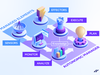
The classic MAPE control loop provides a simple conceptual model for how agents function autonomously. It is a continuous cycle of perception, decision-making and action.
Monitor: Using sensors like APIs and data feeds, the agent perceives the state of its environment.
Analyze: The agent understands the data and its current state to determine what is happening.
Plan: It decides on the next course of action required to achieve its goal.
Execute: The agent uses effectors — its available tools — to take action and implement the plan.

Harvard Business Review Analytic Services pulse survey insights: Going beyond traditional AI and toward agentic AI
Many organizations find themselves unprepared to harness the full potential of AI. This pulse survey from Harvard Business Review Analytic Services reveals that while 94% of leaders recognize the importance of well-connected data for AI success, only 27% have achieved it.
In “Bridging the Readiness Gap to the Agentic Enterprise,” learn about strategies for fully connecting your content and how leading enterprises are thinking about transforming unstructured content into connected pipelines.
Real-world examples of agentic AI workflows
The principles of agentic AI, particularly in multiagent systems, are being applied across industries to solve complex problems and drive new levels of efficiency.
Finance and accounting
In finance, a team of agents streamlines invoice processing. An intake agent captures an invoice, a contract agent verifies it against purchase orders and an approval agent routes it for payment, seeking human confirmation only for exceptions. This collaboration ensures accuracy and speed.
To illustrate this, let's break down how a multiagent team can autonomously process a vendor invoice from receipt to payment.
A multiagent workflow for invoice processing
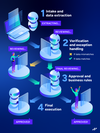
1. Intake and data extraction
The workflow begins when an email with a PDF invoice arrives.
Agent: An Intake Agent monitors the accounts payable inbox.
Tools: It uses an Email API to access the new invoice and Hyland IDP to scan the unstructured PDF.
Action: The agent accurately extracts key data points like vendor name, invoice number, amount due and the associated purchase order (PO) number, creating a structured data record.
2. Verification and validation
The structured data is passed to the next specialist agent.
Agent: A Verification Agent receives the data.
Tools: It uses an ERP API to query the PO number and a Vendor Database API to confirm the vendor is approved.
Action: The agent cross-references all data points to ensure they match the records in the company's systems.
3. Decision and exception handling
The Verification Agent uses its reasoning capabilities to decide the next step.
If data matches: The invoice is validated and passed to the Approval Agent.
If data mismatches: The agent flags the invoice with the specific error. It then initiates a human-in-the-loop step by creating a task for an Accounts Payable specialist to review the discrepancy. The automated workflow for that invoice pauses until the issue is resolved.
> Read More | How AI decision-making transforms enterprise operations
4. Approval and business rules
Once an invoice is verified, it moves to the final agent for approval.
Agent: An Approval Agent receives the verified data.
Action: It applies internal business rules, such as checking if the invoice amount is below a threshold for automatic approval.
5. Final execution
The Approval Agent completes the process based on the rules.
For auto-approval: The agent uses a Payment Gateway API to schedule the payment and the ERP API to mark the invoice as paid.
For manual approval: The agent routes the invoice to the appropriate manager. The manager's approval triggers the agent to complete the final payment and logging steps, closing the loop.
> Read more | How automation and AI can lead financial institutions to success
Customer service and support
A multiagent team can automate the entire lifecycle of a support ticket. An intake agent reviews the ticket, a validation agent checks it against a knowledgebase and a communication agent interacts with the customer. The workflow only escalates to a human agent when necessary, providing a full summary and recommended actions.
> Read more | The power of AI in customer service
Supply chain management
For proactive backorder management, a review agent notifies a customer, a replacement agent checks inventory for alternatives and suggests them, and a fulfilment agent coordinates shipping upon confirmation. This teamwork ensures seamless operations and keeps customers informed.

How to build effective agentic AI workflows
Building reliable and efficient agentic workflows requires a strategic approach. Following best practices ensures that workflows align with business objectives and deliver consistent value.
Define clear, specific goals
An agent needs a well-defined objective to guide its planning and actions. An ambiguous goal will lead to poor or unpredictable results.
Use specialized AI agents
Instead of using one generalist agent, it is often more effective to build workflows with multiple agents, each specializing in a specific task like data gathering or communications.
> Read more | Understand the potential of AI agents
Keep humans in the loop
Design workflows with points for human oversight, review and approval, especially for high-stakes decisions. This builds trust and ensures outcomes align with business goals.
Enable mult-agent collaboration
For highly complex processes, design workflows where agents can share information and coordinate their actions. This allows them to solve problems more effectively than they could alone.
Implement rigorous data governance
Ensure data privacy and compliance by tracking data interactions to create clear audit trails. Apply clear policies for how agents can access and use information.

The role of Hyland Agent Builder in agentic workflows
Hyland provides a powerful solution for creating and deploying the agentic workflows that drive modern automation. Agent Builder enables you to design and manage enterprise-grade AI agents (Enterprise Agents) that can automate complex tasks. These Enterprise Agents can be embedded in Hyland Automate or content management workflows (such as Hyland OnBase or Hyland Alfresco), as well as other automation tools.
It connects directly to the best practices for building effective workflows.
Build enterprise agents
Users can choose from a catalog of prebuilt AI agents or create highly customized agents tailored to specific tasks. The point-and-click interface allows business experts to select the underlying LLM, provide detailed instructions and define the desired output. Agent Builder then enables an iterative process of testing and reconfiguring the agent’s parameters until it consistently achieves the desired outcome.
Enable business experts
Agent Builder is a no-code solution builder, which allows business process experts — not just developers — to build and deploy agents. This accessibility accelerates innovation and empowers those who know the processes best to improve them.
Ensure oversight
The solution enables multiagent collaboration to automatically execute complex workflows while still allowing for human supervision where needed. This aligns with the critical best practice of keeping humans in the loop.
Manage and improve
Agent Builder provides comprehensive agent lifecycle management. It allows users to version, test, deploy, monitor and improve agents continuously to meet evolving business needs, ensuring workflows remain effective over time.
Launch your AI-powered agentic enterprise with Hyland
Hyland's AI-powered and AI-enabled products work together to deliver intelligent automation and unlock the full potential of enterprise content. Agent Builder can orchestrate powerful agentic workflows by leveraging the capabilities of Hyland’s AI-powered suite:
Agent Builder: An agent configuration and lifecycle management tool that enables organizations to use AI agents for specific content-driven tasks. It helps augment the human workforce and implement AI at scale.
Hyland Knowledge Discovery: An AI-powered search, information discovery and decision support application that unlocks access to relevant business insights. It uses AI agents to retrieve and generate information to accelerate decision-making.
Hyland Knowledge Enrichment: A data management tool that transforms raw, unstructured content into structured, high-quality, contextual content for AI-based automation and app development.
Hyland IDP: An AI-powered solution that automates document capture, extraction and classification to enable efficient and accurate data processing.
Hyland Automate: An AI-enabled automation solution designed to simplify complex processes, reduce manual tasks and boost operational efficiency.
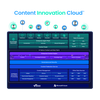
Hyland Content Innovation Cloud™
The platform to power content innovation
Content Innovation Cloud is the future of enterprise content management. By leveraging a unified content, process and application intelligence platform, your organization can unlock profound insights from enterprise content and unstructured data — fueling innovation without disruption.

Article
Elevating experiences: The power of AI in customer service
Learn how AI-driven solutions are transforming customer service and helping organizations deliver personalized, efficient and effective interactions with customers.

Article
How AI Agents are driving smarter business decisions
AI agents for business are transforming industries by improving decision-making and operational outcomes. Designed for scalability, they unlock powerful insights and elevate your organization's competitive edge.

Article
Essential AI terms you need to know
Discover AI essentials for beginners and experts alike with clear explanations that will empower you to navigate the AI landscape confidently.

Article
Driving efficiency with agentic AI for accounts payable
Explore how enterprise AI agents transform financial operations through intelligent automation and autonomous reasoning.