Understanding the different types of AI agents
From simple rule-based bots to complex, collaborative systems, AI agents are transforming how organizations operate. Explore the key types of AI agents and their real-world applications in driving efficiency and intelligent automation.

Summary
Foundational AI agents: Interact with their environment and act to achieve specific goals, from simple reactive models to sophisticated, learning-based systems.
The automation spectrum: AI agents represent a significant leap from basic scripts, offering capabilities from task automation to fully agentic, autonomous operations.
Enterprise and multiagent systems: Specialized agents are transforming business by automating complex processes, while collaborative multiagent systems unlock new value by working together to solve large-scale challenges.
Foundational types of AI agents
AI agents use artificial intelligence to perceive their environment, make decisions and take actions to achieve specific goals. They can operate with varying degrees of autonomy, from following simple rules to learning from experience. Understanding the foundational types provides a base for seeing their enterprise potential.
Agent type | Description | Example use cases |
Simple reflex agents | Use "condition-action" rules to respond to immediate stimuli. | Automated devices that adjust or react directly to their environment. |
Model-based reflex agents | Use an internal model of the world, enabling better decision-making in partially observable environments. | Self-driving cars that predict vehicle movements. |
Goal-based agents | Make decisions by considering future actions that achieve specific goals. | Autonomous drones planning optimal routes. |
Utility-based agents | Evaluate options based on a utility function to maximize overall outcomes and resolve conflicting goals. | Recommendation systems suggesting personalized products. |
Learning agents | Improve performance by learning from feedback and experience over time. | AI personal assistants that refine interactions by analyzing user behaviors. |
Task agents | Single-purpose agents designed to execute specific tasks with structured input and output. | Automating invoice matching in accounts payable, processing citizen service requests. |
Collaboration agents | Conversational agents designed for iterative dialogue with users. | Enable users to ask natural language questions and receive context-aware answers from enterprise content sources. |
RAG agents | Use AI agents to manage the Retrieval-Augmented Generation process, intelligently querying multiple knowledge sources to provide richer context to LLMs. | Advanced question-answering systems and internal knowledge management portals. |
Enterprise agents | Higher-order agents that orchestrate both task agents and collaboration agents to tackle complex, industry-specific problems. | Intelligent medical records review, financial claims assessment and loan exception processing. |

Forrester study: Unlocking the full potential of AI agents
Enterprise-wide AI agent adoption is accelerating
In this Hyland-commissioned study by Forrester Consulting, Forrester found that more than 45% of organizations already use AI agents and another 25% are piloting them. Although adoption is accelerating, most organizations struggle to scale beyond early use cases due to a lack of enterprise context.
Forrester provides key recommendations for how to get AI agents right, as well as detailed data on enterprise trends around agent use. Download this report to learn more about how organizations are looking to AI agents to optimize workflows, make smarter decisions and create more personalized experiences.
Simple reflex agents
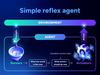
These agents operate on a straightforward "condition-action" basis. They react to immediate environmental stimuli based on a predefined set of rules without considering past events.
For example, a rule might be: IF the temperature is high, THEN activate the cooling system.
Simple reflex agents are best suited for simple, fully observable environments where the current perception is sufficient to make a decision. Common examples include automated doors, thermostats and basic vacuum-cleaning robots that change direction upon hitting an obstacle.
Model-based reflex agents
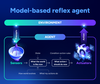
As an evolution of simple reflex agents, these agents maintain an internal "model" or state of the world. This allows them to function effectively in partially observable environments where the current perception alone is insufficient. They use memory of past perceptions to understand how the world changes independently of their actions.
This internal state allows for more informed decisions. A self-driving car, for instance, can use its model to anticipate the movement of other vehicles even when they are temporarily obscured from view, leading to safer and more intelligent navigation.
> Read More | How AI decision-making transforms enterprise operations
Goal-based agents
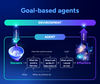
Goal-based agents take decision-making a step further by considering the future consequences of their choices. They can select actions from a range of possibilities that will help them achieve a specific, predefined goal.
Utility-based agents
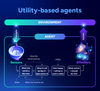
Utility-based agents advance this concept by choosing actions that maximize utility, which is a measure of happiness or success. This allows them to handle conflicting goals by selecting the option with the best overall outcome, providing a more nuanced approach to complex decision-making.
Learning agents
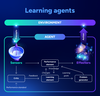
These sophisticated agents can improve their performance over time by learning from experience. A learning agent typically consists of four main components:
Learning element
Performance element
Critic
Problem generator
The performance element executes actions, the critic evaluates how well the agent is doing, and the learning element makes improvements based on that feedback. The problem generator encourages the agent to explore new and potentially better actions, refining its decision-making capabilities through continuous iteration.
> Read more | Understand the potential of AI agents

Harvard Business Review Analytic Services pulse survey insights: Going beyond traditional AI and toward agentic AI
Many organizations find themselves unprepared to harness the full potential of AI. This pulse survey from Harvard Business Review Analytic Services reveals that while 94% of leaders recognize the importance of well-connected data for AI success, only 27% have achieved it.
In “Bridging the Readiness Gap to the Agentic Enterprise,” learn about strategies for fully connecting your content and how leading enterprises are thinking about transforming unstructured content into connected pipelines.
The enterprise automation spectrum: From scripts to agentic AI
Automation has evolved far beyond simple scripts and first-generation chatbots. Today, it represents a full spectrum of capabilities, with agentic AI at the most advanced end. Agentic AI doesn't just respond to commands; it proactively perceives its environment, reasons through problems and acts to drive business outcomes.
This fundamental shift enables organizations to move from automating isolated, repetitive tasks to orchestrating complex, end-to-end processes with intelligent systems. It marks the transition from basic automation to true intelligent automation, where digital entities become active partners in achieving strategic goals.
> Read more | Ultimate guide to enterprise automation
Key AI agent types in an enterprise setting
Within a business context, AI agents are often categorized by their function and scope. Hyland focuses on three primary types that deliver the most significant impact and value: task agents, collaboration agents, enterprise agents and RAG agents.
> Read more | AI agents for business: Driving smarter decisions
Task agents: Automating structured processes
Task agents are single-purpose agents designed to execute a specific, defined task with a structured input and output. They typically run synchronously within workflows, relying on hard-coded prompts or configurations to ensure consistency and precision in their execution.
These agents excel at automating high-volume, rules-based processes. Use cases include automating invoice matching in accounts payable, where one retailer saved $2 million annually. Another example is processing citizen service requests, where a U.K. city council achieved 98% faster case processing and cleared a significant backlog.
Find out more about Hyland Knowledge Discovery.
Collaboration agents: Augmenting human workflows
Collaboration agents are conversational agents designed for iterative dialogue with users to retrieve information or execute tasks. Unlike task agents, they can manage multiple conversations, stop mid-flow to ask for clarification and incorporate human feedback to refine their actions.
The agents in Knowledge Discovery are a prime example of this type. They empower users to ask natural language questions and receive consolidated, context-aware answers drawn from multiple enterprise content sources, effectively augmenting the user's ability to find information.
Enterprise agents: Governed, context-aware intelligence
Enterprise agents provide enterprise-grade AI capability designed to operate within the rigorous constraints of mission-critical workflows. These agents are governed, context-aware and embedded directly into the systems where work happens. In sectors like healthcare, insurance and finance, these agents leverage deep context to facilitate tasks such as intelligent medical records review, financial claims assessment and loan exception processing.
Orchestration happens through a dedicated framework rather than the agents themselves. Using tools like OnBase WorkView, AI-enhanced Hyland Automate, and the agent mesh, organizations coordinate multiple agents to solve broad, industry-specific problems. This orchestration ensures that AI-powered insights fuel complex, multistep solutions from end to end. The result is improved and trusted process outcomes and enhanced productivity across the enterprise.

How IDC views the intelligent content services market
What IDC's intelligent content services analysis means for you
The 2026 IDC MarketScape for Worldwide Intelligent Content Services Applications vendor assessment examines the future landscape of intelligent content services as analyzed by IDC. It focuses on emerging trends and leading vendors.
Download it to explore IDC insights that could redefine how you manage content in your organization. This assessment is an essential read for leaders intent on leveraging enterprise AI to innovate and optimize.
RAG agents: Enhancing context and accuracy
Retrieval-Augmented Generation (RAG) is a technique that connects large language models to external, up-to-date knowledge bases. This allows an AI to generate more accurate and contextually relevant answers by pulling from trusted enterprise information rather than relying solely on its training data.
Agentic RAG enhances this process by using AI agents to orchestrate information retrieval. Instead of connecting to a single data source, these agents can intelligently route complex queries to multiple knowledge bases, plan multistep searches and use different tools to find the best information.
This creates a more adaptive and powerful system. Agentic RAG is ideal for enterprise applications like sophisticated customer support bots that need to access both technical documentation and CRM data, or internal knowledge portals that provide employees with comprehensive answers drawn from across the entire organization.
The power of collaboration: Multiagent systems (MAS)
While single agents can automate specific tasks, the true power of agentic AI is unlocked when multiple agents work together. This collaborative approach, known as a multiagent system (MAS), enables organizations to tackle problems that are too large or complex for any single agent to solve alone.
How multiagent systems work
An MAS is a computational system where multiple autonomous agents interact to achieve individual or collective goals. These agents can be cooperative, working toward a common objective, or competitive, pursuing conflicting goals. They can also be organized in hierarchies to manage complex workflows.
This structure enables emergent behavior, where complex, system-wide patterns and solutions arise from simple, local interactions between individual agents. It provides a scalable and flexible framework for solving dynamic business problems.
> Read more | Multiagent systems: The future of collaborative AI
Hyland Enterprise Agent Mesh: A network of specialized agents
Enterprise Agent Mesh is a Hyland innovation that provides a framework for coordinating how different Enterprise Agents work together. Powered by Hyland Enterprise Context Engine, it enables agents to be aware of each other and the broader business context, allowing for intelligent automation of complex, enterprise-wide processes.
This mesh uses open standards to facilitate communication between Hyland and third-party agents, creating a connected and scalable network rather than a collection of isolated tools. This approach ensures that automation efforts can grow and adapt with the organization.
Implementing and benefitting from AI shouldn't force enterprises to rebuild themselves. The Enterprise Context Engine and Enterprise Agent Mesh AI-enable an enterprise’s existing content and workflows with intelligence and automation, leading to better decisions and more valuable outcomes — not replacing their teams, but empowering them to do more.
Building and managing your own AI agents with Agent Builder
To empower organizations to harness the power of agentic AI, Hyland offers Agent Builder, a low-code tool for creating, managing and deploying highly customizable AI agents. It provides a comprehensive platform for bringing intelligent automation to life.
Key features of Agent Builder
Agent Builder enables comprehensive lifecycle management, allowing users to version, test, deploy, monitor and continuously improve agents. It simplifies the creation of powerful agentic solutions that drive modern automation.
Design with purpose: Build enterprise agents from the ground up or jumpstart your journey with prebuilt agents from our catalog. Whether task-oriented or collaboration-focused, these agents leverage your unstructured content to integrate seamlessly into existing workflows.
Intuitive point-and-click interface: Easily manage agent behavior with precision. Our streamlined interface lets you select AI models, provide instructions, and define outcomes without needing to write complex code.
Scalable human oversight: Innovation requires accountability. Agent Builder integrates robust human-in-the-loop (HITL) capabilities, allowing you to balance human-AI collaboration based on the complexity or sensitivity of the task. Critical or high-risk decisions benefit from human nuance, blending automation's speed with reliable judgment.
Governed by design: Ensure enterprise-grade governance from day one. Unlike consumer AI tools, Agent Builder extends your data governance strategies directly to AI models and their outputs, maintaining security and compliance at every step.
Context-aware by default: Agents act on AI-ready data combined with deep business context. Hyland doesn’t just understand documents — we understand the decisions, tasks and workflows that drive your industry.
Automate complex multiagent workflows: Move beyond simple tasks. Coordinate multiple enterprise agents to tackle multistep workflows traditionally reliant on manual intervention, processing large volumes of information with speed and accuracy.
By embedding these agents into your workflows via REST APIs or Enterprise Agent Mesh, you create a future-ready, scalable workforce backed by decades of industry expertise.

Article
Your agentic enterprise: The new reality of AI and enterprise content
Two breakthrough innovations radically expand the reality of what ECM means. With Hyland’s bold approach to weaving AI into your content universe, you can move faster than ever and realize incredible outcomes.

Article
Streamline automation by embedding agentic AI workflows
Discover how AI agents are transforming business processes from rigid, rule-based tasks into dynamic, goal-oriented systems that can reason, plan and adapt.

Article
How AI Agents are driving smarter business decisions
AI agents for business are transforming industries by improving decision-making and operational outcomes. Designed for scalability, they unlock powerful insights and elevate your organization's competitive edge.