A guide to multiagent systems: The future of collaborative AI
Discover how decentralized networks of intelligent agents are teaming up to solve complex problems, automate intricate workflows and drive enterprise-wide innovation.

Summary
A multiagent system (MAS) is a collaborative network of intelligent agents, marking a significant shift from monolithic AI models.
Core challenge and solution: Businesses often can't automate complex, multi-step processes that need dynamic decision-making. MAS solves this by distributing tasks among specialized agents that collaborate to achieve a common goal, which accelerates business outcomes.
Key capabilities: MAS uses multiple autonomous agents, each with a specific role and powered by an LLM. These agents perceive their environment, communicate and coordinate actions to run complex agentic workflows with greater flexibility and robustness.
Strategic value: By orchestrating specialized agents, organizations can cut operational risks and costs tied to repetitive data work. This drives faster, more informed decision-making across the entire enterprise.
What is multiagent AI?
A multiagent system (MAS) is a collection of autonomous, interacting computational agents working within a shared environment. They're designed to solve problems as a team. This approach moves beyond centralized control. MAS features distributed decision-making, which enhances adaptability and scalability for complex tasks.
This is a sharp contrast to monolithic programs. The MAS paradigm uses specialized "experts" that collaborate to achieve a goal, rather than relying on a single, all-knowing program.
> Read more | AI agents, AI assistants and agentic AI
Single agent vs. multiagent systems
A single-agent system has one autonomous entity operating alone to achieve a goal. It’s best for well-defined problems that don't require much external interaction.
A multiagent system involves multiple agents that collaborate, compete, or negotiate in a shared environment. This distributed model is perfect for complex, dynamic challenges that would overwhelm a single agent.
The trade-off is clear: single-agent systems are simpler to build, but multiagent systems deliver superior flexibility, robustness and scalability, though their design is more complex.
Feature | Single-Agent System | Multi-Agent System (MAS) |
Architecture | Centralized, solitary entity | Distributed, collaborative network |
Problem Scope | Well-defined, isolated tasks | Complex, dynamic, large-scale challenges |
Complexity | Lower; easier to build/debug | Higher; requires coordination protocols |
Scalability | Limited | High; add agents to handle load |
Robustness | Single point of failure | High; agents can cover for failures |
Interaction | Minimal or none | Constant communication/negotiation |
> Read more | Types of Ai agent and their use cases

Harvard Business Review Analytic Services pulse survey insights: Going beyond traditional AI and toward agentic AI
Many organizations find themselves unprepared to harness the full potential of AI. This pulse survey from Harvard Business Review Analytic Services reveals that while 94% of leaders recognize the importance of well-connected data for AI success, only 27% have achieved it.
In “Bridging the Readiness Gap to the Agentic Enterprise,” learn about strategies for fully connecting your content and how leading enterprises are thinking about transforming unstructured content into connected pipelines.
How do multiagent systems work?
Agents continuously observe their environment, leverage LLM-based reasoning to make informed decisions and execute tasks.
In multiagent systems, productivity is driven by orchestration. Agents coordinate their efforts through direct communication or by modifying the shared environment (a process known as stigmergy) to ensure seamless collaboration. Complex multistep tasks are broken down into structured, agentic workflows managed by an orchestrator or a graph-based structure.
This managed, goal-oriented approach is exactly how Hyland orchestrates specialized agents to cut business cycles and deliver measurable ROI.
To understand how these systems scale and perform in real-world environments, it is essential to examine the core components and architectural patterns that define their behavior.
Independent agents
Agents are active, decision-making entities. They have a degree of autonomy, so they can perceive their local environment and act on their objectives. An agent's reasoning is often powered by an LLM that acts as its "brain" for understanding intent and planning actions.
Shared environment
The environment is the shared space (virtual or physical) where agents operate, interact and access resources. It imposes constraints and also serves as a medium for indirect communication. For example, one agent might modify a digital file that another agent then observes and acts upon.
Communication is key
Agents need clear rules to talk to each other. This requires communication protocols (like JSON over HTTP) and standardized Agent Communication Languages (ACLs) such as FIPA ACL. FIPA ACL is a structured language based on speech-act theory, with fields for the sender, receiver, communicative act (e.g., "request") and the content of the message.
Coordination for success
Coordination mechanisms are the methods agents use to align on goals and work effectively as a team. Examples include task bidding, where agents place bids in an auction for tasks, or using contract nets to distribute the workload. Agents might also vote on decisions to reach a consensus.
Structures of multiagent systems
Different architectural patterns exist for coordinating agents. Each offers distinct advantages for different types of problems.
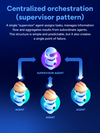
A single "supervisor" agent assigns tasks, manages information flow and aggregates results from subordinate agents. This structure is simple and predictable, but it also creates a single point of failure.
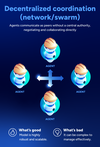
Agents communicate as peers without a central authority. They negotiate and collaborate directly. This model is highly robust and scalable, but it can be complex to manage effectively.
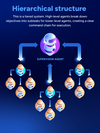
This is a tiered system. High-level agents break down broad objectives into manageable subtasks for lower-level agents, creating a clear command chain for execution.
Custom/graph-based workflows
Agents operate within a graph structure, like those used in LangGraph. This allows for complex, cyclical, and stateful interactions where agents can loop and self-correct based on the process state. This structure is essential for Hyland Enterprise Agent Mesh, which coordinates agents to execute intelligent processes across the enterprise.
Coalition/team-based
Agents form temporary groups or "coalitions" to tackle specific tasks. This is often seen in frameworks like CrewAI where role-playing agents (e.g., "researcher," "writer") form a team to complete a project.
Behaviors of multiagent systems
One of the most powerful aspects of MAS is emergent behavior. The collective actions of simple, rule-following agents can lead to complex and intelligent global patterns that weren't explicitly programmed.
Flocking
Agents follow simple rules: separation, alignment and cohesion. This allows them to move as a coordinated group without a leader. You can see this behavior in drone swarms or graphical simulations.
Swarming
Inspired by insect colonies, swarming involves agents working together to achieve a goal that is beyond the capabilities of any single agent. They often use the environment for indirect communication to coordinate their actions.
> Read more | Understand the potential of AI agents

Forrester study: Unlocking the full potential of AI agents
Enterprise-wide AI agent adoption is accelerating
In this Hyland-commissioned study by Forrester Consulting, Forrester found that more than 45% of organizations already use AI agents and another 25% are piloting them. Although adoption is accelerating, most organizations struggle to scale beyond early use cases due to a lack of enterprise context.
Forrester provides key recommendations for how to get AI agents right, as well as detailed data on enterprise trends around agent use. Download this report to learn more about how organizations are looking to AI agents to optimize workflows, make smarter decisions and create more personalized experiences.
Use cases of multiagent workflows
The question is no longer if you should automate; it is how you can use collaborative AI to solve high-stakes business challenges. By orchestrating specialized agents, Hyland helps organizations move beyond isolated task automation to achieve end-to-end process excellence.
Healthcare revenue cycle and clinical operations: Orchestrate a network of agents to handle prior authorization intake—where one agent extracts clinical data, another verifies insurance eligibility against payer portals and a third flags exceptions for human review. This accelerates patient care and reduces administrative burden.
Financial services and lending: Streamline complex customer onboarding and KYC (Know Your Customer) compliance. A multiagent team can simultaneously ingest identity documents, validate data against internal systems, perform risk assessments and trigger automated compliance reporting, significantly reducing time-to-decision.
Government and public sector: Automate grant management and permit processing. Agents can classify inbound application materials, extract critical eligibility data, cross-reference public records and route complete files to the appropriate department, ensuring faster service delivery for constituents.
Higher education administration: Optimize student financial aid and transcript processing. Agents can ingest high volumes of academic records, extract key data points for credit evaluation and update student information systems, freeing staff to focus on student advising and retention.
Enterprise content and AP automation: Beyond simple invoice processing, deploy agentic teams to manage the entire invoice-to-pay cycle. Agents can reconcile invoices against purchase orders, detect potential fraud patterns and manage complex exception handling across disparate ERP systems.
> Read more | How AI agents are driving smarter business decisions
Benefits of multiagent systems
Multiagent systems transform complex, manual operations into resilient, high-speed workflows. By orchestrating specialized, autonomous agents, organizations gain the scalability to handle shifting demands, the robustness to ensure continuous operations and the efficiency to accelerate business cycles. All of this is achieved while reallocating human talent to higher-value strategic work.
Scalability: Systems can handle increased workloads by adding more agents without a full redesign, similar to how Hyland Cloud provides massive scale.
Flexibility and adaptability: Agents can be added or modified to address new challenges, so the system can evolve with business needs.
Robustness: The system can keep functioning even if individual agents fail. Other agents can take over their tasks, ensuring high availability for mission-critical processes.
Efficiency: Parallel processing allows MAS to solve complex problems faster and with more efficient use of computational resources.
Domain specialization: You can create highly specialized agents, like an agent for data extraction and another for compliance checks, that bring deep expertise to their part of a workflow.
> Read more | Harnessing the benefits of artificial intelligence (AI) in business
Challenges of multiagent systems
Multiagent systems offer significant advantages, but they introduce operational hurdles that require careful architectural planning. Organizations must address these challenges to ensure their automated workflows remain secure, predictable and cost-effective.
Coordination complexity: Ensuring many autonomous agents work together harmoniously without conflict or deadlock requires a modelling and orchestration platform capable of operating at enterprise scale.
Security: In systems sharing sensitive data, malicious agents can introduce risks by providing false information or leaking confidential data. Secure agent communication is paramount.
Explainability and debugging: The emergent and non-deterministic behavior of multiagent systems makes it difficult to trace errors and understand why a particular outcome occurred.
Factual grounding: LLM-powered agents can generate incorrect information. Ensuring outputs are grounded in trusted, factual data sources is a major hurdle that requires a strong data foundation.
Cost of operation: Heavy reliance on API calls to powerful LLMs can lead to significant computational costs, especially when scaling the system.
> Read more | AI in the workplace: Navigating a new frontier

Subscribe to The Shift
Hyland’s monthly newsletter helps you elevate your content management strategy
Offering unparalleled insights into the AI and cloud technologies transforming what content can do, The Shift gives you actionable strategies from industry thought leaders. Learn from real-world success stories and innovative perspectives that will keep your organization at the forefront of ECM transformation.
Subscribe to stay ahead, stay informed and make your enterprise content an even more strategic asset.
Begin your intelligent journey
Multiagent systems are changing how we approach complex automation. By moving from single AI models to collaborative agent networks, organizations can achieve new levels of efficiency, resilience and intelligence. Hyland Content Innovation Cloud™ provides the foundation for this shift.
Through capabilities like Hyland’s AI-native Agent Builder, as well as Enterprise Agent Mesh and Enterprise Context Engine, Hyland helps you orchestrate intelligent automation at scale. This approach ensures your AI initiatives are not only powerful but also grounded in trusted data, governed responsibly and aligned with your specific business context.
Hyland Content Innovation Cloud™
The platform to power content innovation
Hyland Content Innovation Cloud is the future of enterprise content management. By leveraging a unified content, process and application intelligence platform, your organization can unlock profound insights from enterprise content and unstructured data — fueling innovation without disruption.

Article
Real-world agentic AI use cases by industry
Explore real-world agentic AI use cases across healthcare, finance, HR and more. See how AI agents can automate workflows, lower costs and accelerate business growth.

Article
Mastering unstructured data management in 2026
Transform unorganized information into AI-ready assets to drive smarter decisions, innovation and efficiency.

Article
Elevating experiences: The power of AI in customer service
Learn how AI-driven solutions are transforming customer service and helping organizations deliver personalized, efficient and effective interactions with customers.

Article
Business benefits of retrieval-augmented generation
Retrieval-augmented generation redefines how businesses harness information, merging AI capabilities with authoritative data to drive accuracy and innovation