
Summary
Colleges and universities face increasing pressure to deliver faster, more personalized student services while managing enrollment volatility, budget constraints and growing compliance demands. However, critical information often remains trapped in disconnected systems across admissions, registrar, financial aid and student services.
Content intelligence and AI- and data-driven automation help institutions modernize document-centric workflows by connecting content across systems and transforming unstructured data into actionable information. Together, they also enable process automation with human-in-the-loop (HITL) oversight. Institutions are using these capabilities to:
Accelerate admissions, financial aid and student service workflows with AI-enabled automation
Eliminate manual processes and bridge disconnected systems with connected, AI-ready content
Improve operational efficiency and decision-making with explainable, auditable workflows
Why institutions are turning to AI for enterprise content management
85% of enterprise content is unstructured, including emails, video files and memos.
Content is often scattered across 24 systems, on average.
Staff spend about 25% of their work week searching for information.
Just 30% of organizations use AI-enabled automation to drive impact in content-related processes.
Academic and administrative leaders recognize that solutions capable of surfacing, governing and deriving intelligence from content across databases can significantly improve student experiences and productivity. By bringing content into context, institutions can increase throughput and responsiveness.
Connecting fragmented repositories and applying AI to extract, enrich and act on content can unlock faster admissions and transfer evaluations, cleaner financial aid packaging, quicker student services and easier audits — without the need to rip and replace existing enterprise systems.
5 drivers for modern enterprise content management
To win in the digital era, you need to move fast, adapt quickly and innovate. Can your ECM meet the moment?
Legacy ECM systems were architected for a different time. They are too inflexible and technically limited for today’s dynamic business and computing environments, and they don’t support today’s anywhere-work requirements. Download this e-book to discover if the top five legacy ECM roadblocks impact you — and how you can overcome them.
What is content intelligence?
Content intelligence integrates AI across the information life cycle to transform unstructured data into usable, discoverable and actionable information that supports smarter workflows and faster decisions.
For example, staff can use AI tools to summarize complex transcripts quickly or surface key insights from large volumes of documents. In fact, 60% of organizations now prioritize content intelligence.
Content intelligence comprises three core capabilities:
Knowledge enrichment
Ingest, curate and enrich metadata using predictive AI models. Content is analyzed to generate new metadata, which is linked back to the original source while protecting sensitive information such as personally identifiable information (PII).
Knowledge discovery
Use simple natural language query to find information and generate insights grounded in institutional data and large language models (LLMs). For example, “Show FAFSA verification documents missing signatures for PEL-eligible students admitted for Fall 2026”.
Agent builder
Configure AI agents, with governance controls, to perform content‑driven tasks or support multiagent workflows, such as admissions file completeness checks or transcript summarization.
> Read more | The potential of AI agents
What is AI-powered process automation?
AI-powered process automation integrates AI with automation to manage complex processes more efficiently and adapt to real-time data. Instead of just automating static tasks, systems can learn, route and respond dynamically.
For higher education, this results in fewer manual steps, errors and faster cycle times across document‑centric processes such as admissions, financial aid, registrar updates and student services — while maintaining human-in-the-loop (HITL) oversight for complex decisions.
Core capabilities of AI-powered automation
Intelligent document processing (IDP) is a key capability of AI-powered automation, enabling organizations to extract, interpret and act on data from enterprise content with minimal human intervention. It transforms unstructured and semi-structured information into usable data that can power business applications and drive actionable insights.
IDP processes data across a wide range of dynamic formats — including reports, emails and images — at speed and scale. With these capabilities, institutions can eliminate bottlenecks and streamline document-intensive workflow:
Intelligent data capture: Reduces manual effort and exceptions using deep learning and optical character recognition (OCR) to accurately capture information from documents.
Automated document separation and classification: Accelerates processing by automatically identifying, organizing and categorizing documents within large batches.
AI-powered data extraction: Improves accuracy by extracting and validating data using AI-driven models, minimizing errors and rework.
With IDP, every AI-driven decision is explainable, giving institutions full transparency into how information is interpreted and processed.
Five platform capabilities that drive institutional efficiency
To maximize the value of AI, institutions need a modern enterprise content management system with five key capabilities:
Cloud-native and scalable
Cloud-native platforms allow institutions to rapidly deploy new capabilities, ensure resiliency, improve integrations and scale operations as needs evolve.
Content federation
Content federation helps manage and govern records in place across repositories, shared drives and databases — avoiding costly migrations while unifying search and policy.
Low-code application development
Low-code tools accelerate modernization and AI enablement while empowering departments to build workflows without heavy custom code under IT governance.
Secure information governance
Automated governance capabilities support retention, legal holds, e‑discovery and records management, maintaining a single source of truth with robust auditing for accreditation and regulatory reviews.
Deep systems integration
Modern solutions use APIs to integrate seamlessly with SIS, ERP and CRM systems to preserve operational continuity while supporting AI-driven modernization.
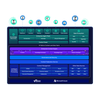
Explore Hyland Content Innovation Cloud™
The Content Innovation Cloud is the future of enterprise content management. By leveraging a unified content, process and application intelligence platform, your organization can unlock profound insights from enterprise content and unstructured data — fueling innovation without disruption.
Putting content intelligence and AI-powered automation to work
Institutions can deploy these capabilities across a wide range of use cases:
Admissions, financial aid and student advising: Automate capture and extraction, perform completeness checks and orchestrate routing with HITL oversight. This results in faster decisions, fewer errors and improved service levels during peak cycles.
Transcript processing: Automatically classify transcripts, extract academic data and summarize records against institutional policies to accelerate transfer credit decisions and placement. It can also flag missing information or risks using explainable logic and confidence thresholds.
Financial aid scholarship assistance: Extract and validate data from forms, run agent-assisted eligibility checks and enable faster, more accurate packaging decisions.
Cloud migration via federation: Apply governance, security and AI‑readiness to existing repositories without disruptive migrations; creating a foundation to scale automation.
> Read more | Benefits of a low-code solution
An AI-ready framework for higher education
Institutions must address several challenges before they invest in AI to unlock the full potential of their enterprise content. Currently, more than 60% of leaders say their technology and governance frameworks aren’t AI-ready.
Collaborate with a strategic partner who offers a robust AI framework anchored on five pillars:
Infrastructure: Establish a cloud foundation and API connectivity to unite content and enable secure automation.
Content: Assess quality, fill gaps and enrich data to create AI‑ready information.
Governance: Define access controls, monitoring and policies for responsible data use and sharing. Consider an AI council with academic and administrative representation.
Ethical AI: Ensure transparency, explainability, bias monitoring and HITL controls — especially for admissions, aid and student success use cases.
Skills development: Build AI literacy and create champions — across enrollment, registrar, financial aid, finance, HR, research admin and IT — to adopt and scale solutions effectively.

Private university achieves 114% ROI with Hyland Cloud
Nucleus Research studies the impact of Hyland Cloud
Discover how a leading private university revolutionized its operations with Hyland Cloud, achieving an impressive 114% return on investment in just over a year. The institution saved $275,000 annually, streamlined processes and embraced a digital-first approach. Explore this success story to see how innovation drove measurable outcomes and transformed higher education.
Modernize at the speed of trust
Content intelligence and AI-powered automation provide a clear path to faster decision-making, improved student experiences and increased productivity. Leading institutions are starting with low‑risk use cases, demonstrating value quickly and scaling responsibly with explainable, auditable AI.
The result is faster admissions and transfer decisions, more accurate financial aid processing, more productive staff and greater institutional trust in AI‑driven outcomes.
Hyland’s approach to AI emphasizes a pilot‑first model, value-based confidence thresholds, HITL workflows and full auditability. This enables teams to demonstrate results quickly and scale responsibly across departments.
For more information, explore Hyland’s higher education expertise.

Brochure
Powering the digital campus
Hyland's higher education solutions.

Article
Low-code vs. no-code: Getting started
Understand the difference between low-code, no-code and pro code and which is best for you.

Article
What can you do with Hyland IDP?
Hyland's AI-powered intelligent document processing solution brings instant value and efficiency to teams that work with document capture, classification, extraction and validation.

Case Study
Bellevue University accelerates end-to-end automation with Hyland Automate
Bellevue University utilizes Hyland Automate to modernize forms and workflows, reduce manual effort and build a scalable foundation for long-term digital transformation.