Deploying Agentic AI for Customer Service: A Strategic Guide
Move beyond simple chatbots to autonomous, goal-oriented service that enhances CX and drives measurable ROI.

Summary
Agentic AI offers a new economic model for customer support that decouples operational costs from ticket volume.
Redefine support economics: Replace headcount-driven scaling with agentic AI that automates end-to-end workflows, lowering operational costs and accelerating resolutions.
Build an enterprise workforce: Use Hyland Agent Builder to create Enterprise Agents — powered by Hyland Knowledge Discovery and Cloud Federation Service — to connect them to enterprise-wide data.
Orchestrate complex tasks: Apply AI-enhanced Hyland Automate and the Enterprise Agent Mesh to manage complex, multi-system processes.
Drive strategic growth: Deliver greater efficiency, improved customer experiences and data-driven insights that turn customer support from a cost center into a growth engine.
Modernizing customer service with autonomous outcomes
Customer service teams are under pressure. Costs are rising and the old model of adding more people to handle more tickets is no longer viable. Agentic AI offers a different path. It’s not about simple automation; it’s about creating autonomous, goal-oriented systems.
Agentic AI becomes a digital colleague
Don’t confuse AI agents with traditional chatbots. A chatbot follows a pre-written script, answering one question at a time. An AI agent is a digital colleague designed to achieve a specific goal.
An agent's core functions are what set it apart. It reasons to understand a user's true intent, plans a sequence of multi-step actions and acts across different systems to get the job done. This allows it to handle complex queries involving multiple issues — something a single-turn bot cannot manage.
> Read more | AI Agents, AI Assistants and Agentic AI
Moving from ticket deflection to goal resolution
The old metric was ticket deflection. The goal was to prevent a customer from creating a support ticket. The new standard is end-to-end goal resolution.
Instead of just answering a question about a return policy, an agent can receive the request, verify the order in your ERP, process the refund via an API and notify the customer that the transaction is complete. It completes the entire process autonomously, accelerating the business and freeing up human teams for more complex work.

Harvard Business Review Analytic Services pulse survey insights
Going beyond traditional AI and toward agentic AI
Many organizations find themselves unprepared to harness the full potential of AI. This pulse survey from Harvard Business Review Analytic Services reveals that while 94% of leaders recognize the importance of well-connected data for AI success, only 27% have achieved it.
High-impact customer service use cases for the agentic workforce
The opportunities for an agentic workforce extend far beyond basic Q&A. These systems can take on core service operations to fuel productivity.
Intelligent ticket triage and routing: Agents analyze incoming communications for intent, sentiment and urgency. They can automatically route tickets to the correct human team or handle the request themselves.
Proactive issue prevention: Agents monitor system data like shipping delays or product usage logs. They identify potential customer problems before they happen and can initiate proactive outreach or create a support ticket automatically.
Real-time agent assistance: In a "co-pilot" model, assistive agents work alongside human representatives. They provide real-time conversation transcription, surface relevant knowledge from your databases and suggest responses to reduce handle times and improve service consistency.
End-to-end refund and order management: An agent can execute a complete multi-step workflow. It can receive a request, look up order data in an ERP, check policy compliance, initiate the refund and update the customer record in your CRM without human intervention.
> Read more | The Power of AI in Customer Service
Measurable benefits of AI agents in customer service
Deploying an agentic workforce delivers direct, measurable improvements to both your operations and your customers’ experiences. It’s a fundamental shift in how service is delivered.
24/7 availability and instantaneous response: AI agents provide around-the-clock support. This eliminates customer wait times and offers consistent service across all time zones.
Seamless scalability: Manage significant increases in customer inquiries without a proportional increase in staffing costs, breaking the traditional linear cost model.
Enhanced data-driven insights: Agents can analyze customer interactions. This helps you identify trends, sentiment shifts and emerging issues, providing actionable intelligence for faster, more-informed business decisions.
Improved employee experiences: By automating repetitive, low-value tasks, agentic AI frees human agents to focus on complex, high-empathy customer issues. This reduces burnout and increases job satisfaction.
> Read more | Harnessing the benefits of artificial intelligence (AI) in business
How to deploy agentic RAG for customer service automation
Agentic AI does not work in a vacuum. It needs high-quality, relevant information to make better decisions. This is where agentic Retrieval-Augmented Generation (RAG) becomes essential.
Step 1: Build a hybrid retrieval pipeline
Agentic RAG relies on a sophisticated data foundation. Intelligent systems cannot function effectively on siloed or fragmented information.
The first requirement is a hybrid search strategy that pairs vector search for semantic intent with keyword search for exact identifiers such as product codes or SKUs. This ensures the agent has the correct context before attempting a resolution. To achieve this, organizations must establish a consolidated view of information that bridges multiple repositories to ensure data is better prepared for the retrieval process.
> Read more | Business benefits of retrieval-augmented generation
Step 2: Transition from information retrieval to workflow execution
While standard RAG provides the necessary knowledge, agentic AI introduces the execution layer. The objective is to move beyond simple information retrieval to workflow execution.
By granting agents the ability to call APIs and interact with systems of record such as CRMs, ERPs or ticketing platforms, organizations can automate the entire lifecycle of a customer request rather than just answering a query. This shift allows the system to perform tasks, update records and close cases autonomously to create a more efficient and responsive support model.

Forrester study: Unlocking the full potential of AI agents
Enterprise-wide AI agent adoption is accelerating
In this Hyland-commissioned study by Forrester Consulting, Forrester found that more than 45% of organizations already use AI agents and another 25% are piloting them. Although adoption is accelerating, most organizations struggle to scale beyond early use cases due to a lack of enterprise context.
Forrester provides key recommendations for how to get AI agents right, as well as detailed data on enterprise trends around agent use. Download this report to learn more about how organizations are looking to AI agents to optimize workflows, make smarter decisions and create more personalized experiences.
A roadmap for AI agent development
Getting started with agentic AI does not require a "big-bang" approach. A phased, strategic rollout delivers quick wins and builds momentum for wider adoption.
Starting with high-volume, low-risk tasks
Begin with a focused pilot. Identify repetitive, predictable workflows like order status inquiries, password resets or answering FAQs. These are perfect candidates for automation.
Designing logic and safety guardrails
Governance is critical. You must build in safety guardrails from the start. This includes using confidence scoring to assess the agent's certainty and creating clear escalation paths to a human agent when a confidence threshold is not met.
The companies that thrive in the AI era won’t be the ones asking, ‘How can we do more with fewer people?’ They’ll be the ones asking, ‘How can we help our people do their most meaningful work?
Measuring the ROI of Agentic AI implementation
The business case for agentic AI is clear. It changes the economics of customer service and delivers a strong return on investment by removing repetitive data work.
Decoupling ticket volume from headcount
The ROI model shifts from a linear relationship between volume and headcount to a scalable, automated one. When organizations automate high-volume tasks, the results are quantifiable. For example, Redstone Federal Credit Union saved 2,000 hours per year using Hyland’s automation and workflow capabilities.
> Read more | What are agentic workflows
Enhancing First Contact Resolution (FCR)
Agents with access to federated data and the ability to execute actions can resolve a higher percentage of issues on the first contact. This directly improves customer satisfaction. It also reduces escalations and minimizes repeat contacts, which lowers the overall cost per resolution.
"Investing in artificial intelligence for growth, efficiency and competitiveness isn't a leap of faith anymore, but a strategic necessity for businesses," said Tiago Cardoso, principal product manager at Hyland.

Subscribe to The Shift
Hyland’s monthly newsletter helps you elevate your content management strategy
Offering unparalleled insights into the AI and cloud technologies transforming what content can do, The Shift gives you actionable strategies from industry thought leaders. Learn from real-world success stories and innovative perspectives that will keep your organization at the forefront of ECM transformation.
Subscribe to stay ahead, stay informed and make your enterprise content an even more strategic asset.
Engineering adaptability with Hyland
Long-term success with AI is not about writing the perfect prompt. It’s about building an adaptable system that understands your business.
Context engineering over brittle prompts
Prompt engineering is a short-term tactic that relies on manual and often brittle instructions. The sustainable strategy for scalable automation is context engineering. This discipline focuses on providing agents with a living and real-time map of how content, processes, people and applications are interconnected across the organization.
Instead of relying on a static prompt to explain a task, context engineering allows an agent to query the enterprise environment to understand the relationships between a customer, their history and the relevant business rules. This deep intelligence ensures that agents can reason through complex scenarios and adapt to new variables without requiring constant manual re-tuning of the underlying code.
Hyland’s Enterprise Context Engine provides this intelligence. It makes agent decisions more relevant and adaptable to changing business conditions, so your automations do not fail when a process changes.
Bridging data silos with agentic decisioning
For AI agents to execute autonomous decisions, they must navigate the fragmented architecture of the modern enterprise. Data silos often trap critical information within disconnected CRMs, ERPs and legacy repositories, which creates blind spots that hinder automated reasoning.
When agents lack visibility across these disparate systems, they cannot validate information or handle exceptions without human intervention. Addressing this challenge requires a connectivity layer that aggregates distributed data into a unified perspective. By federating this information instead of undergoing risky and expensive data migrations, organizations provide agents with the high-quality context needed to act effectively across the entire support ecosystem.
> Read more | Understanding and overcoming information silos
Begin your intelligent journey
Hyland provides the foundation for the agentic enterprise through the Hyland Content Innovation Cloud™. This suite of capabilities makes your content AI-ready with tools like AI-powered Hyland IDP and Hyland Knowledge Enrichment. It provides enterprise-wide context for decision-making through the Enterprise Context Engine and orchestrates autonomous workflows through a network of intelligent agents. By starting with your enterprise content, Hyland helps you move from experimenting with AI to operationalizing it at scale.
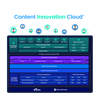
Hyland Content Innovation Cloud™
The platform to power content innovation
Content Innovation Cloud is the future of enterprise content management. By leveraging a unified content, process and application intelligence platform, your organization can unlock profound insights from enterprise content and unstructured data — fueling innovation without disruption.
What’s the difference between a traditional chatbot and an AI agent?
Traditional chatbots typically follow predefined scripts to answer isolated questions one at a time. In contrast, AI agents act as digital colleagues that reason through user intent, plan multi-step actions and execute tasks across disparate systems. While a chatbot might deflect a ticket by providing an article, an AI agent can resolve the underlying goal autonomously.
How does agentic AI improve customer service ROI?
Agentic AI shifts the economic model of support by decoupling ticket volume from headcount. By automating repetitive data work and high-volume tasks at near-zero marginal cost, organizations can scale their operations without a proportional increase in staffing.
What’s context engineering and why is it better than prompt engineering?
Prompt engineering is a short-term tactic that relies on manual, static instructions. Context engineering is a long-term strategy that provides AI agents with a real-time map of how an organization’s content, processes and people are interconnected. Using the Hyland Enterprise Context Engine, agents can query this living record to make decisions that are more relevant and adaptable to changing business conditions.
Can AI agents handle complex workflows across different systems?
Yes. By moving beyond simple information retrieval to workflow execution, AI-powered Hyland Agent Builder allows agents to call APIs and interact with systems of record such as CRMs, ERPs or ticketing platforms. This enables the autonomous completion of entire business processes, such as verifying an order and processing a refund, without human intervention.
How do you ensure AI agents make safe and reliable decisions?
Responsible AI deployment requires the implementation of logic and safety guardrails from the start. This includes using confidence scoring to evaluate the certainty of an agent's decision and establishing clear escalation paths to human representatives when a specific threshold is not met. This ensures that human-in-the-loop oversight remains a core part of the automated process.

Article
Explore the power of AI agents
AI agents are revolutionizing the way we work. These intelligent digital workers automate tasks, improve efficiency and unlock new possibilities.

Article
How AI Agents are driving smarter business decisions
AI agents for business are transforming industries by improving decision-making and operational outcomes. Designed for scalability, they unlock powerful insights and elevate your organization's competitive edge.

Article
Mastering unstructured data management in 2026
Transform unorganized information into AI-ready assets to drive smarter decisions, innovation and efficiency.

Article
Navigating the pros and cons of unstructured data
Provide a brief summary of the page content (Search results page).