
Summary
AI and data-driven automation in higher education help institutions optimize and orchestrate document-heavy workflows using policy-aware logic, AI-enhanced capabilities and human oversight where needed.
Legacy systems and siloed repositories limit automation, reduce visibility and increase operational risk.
AI-powered workflow automation connects systems and content to streamline admissions, financial aid and student services.
A governed approach to AI helps institutions improve compliance, reduce cost-to-serve and support more efficient campus operations.
By adopting AI-ready content management and intelligent automation, colleges and universities can modernize operations, improve decision-making and deliver faster, more responsive experiences for students and staff.
Higher education is moving beyond traditional automation
Colleges and universities have spent the past decade digitizing paper, modernizing SIS and ERP systems and building online services for students. But rising expectations for speed, affordability and personalization — combined with enrollment volatility, workforce shortages and heavily fragmented systems — mean traditional automation can only go so far.
That’s why institutions today are reimagining digital transformation — advancing from basic digitization to AI-assisted, data-driven automation that streamlines document-centric workflows, boosts productivity and speeds decisions.
This shift is about applying explainable, policy-aware AI where it delivers measurable impact — in admissions, financial aid, registrar workflows, student services and institutional operations — all while ensuring safety, equity and audit readiness.
Higher education leaders overwhelmingly see the potential:
EDUCAUSE 2026 highlights AI‑powered efficiencies and measured approaches as top priorities.
76% of global ECM decision-makers agree the next wave of digital transformation will focus on AI agents leveraging enterprise knowledge.
45% of institutions are already using AI agents and 25% are piloting them, with most others planning adoption within 12 months.
AI‑enhanced content management and process automation act as a force multiplier for digital transformation. By unifying content across repositories, applying governance and introducing AI-supported automation with human‑in‑the‑loop (HITL) controls, institutions can accelerate student- and staff-facing processes, reduce cost-to-serve and modernize at the speed of trust.

Explore Hyland's modernized enterprise content management solutions
Revolutionize your content management approach
Hyland offers a modern content management platform tailored to revolutionize your workflows and enhance productivity. Discover a new perspective on enterprise content management and redefine the way you handle content, empowering you to make informed decisions faster than ever before.
Accelerate processes with policy-aware AI automation
Higher education processes run on structured and unstructured information — including transcripts, financial aid forms, appeals, applications and degree audits. According to recent studies, as much as 85% of enterprise content can be unstructured, including emails, video files and memos. Additionally, 68% say unstructured data volume is growing rapidly and represents untapped insight.
But many legacy systems are too outdated to process large amounts of information or leverage it for valuable insights. That limits efficiency, data accessibility and service delivery to students.
Universities and colleges should look to AI‑assisted capture, validation and agentic workflows to accelerate processes.
Capabilities such as:
Intelligent document processing (IDP) leverage AI-powered separation, classification, extraction and validation for transcripts, applications and financial aid documentation — improving speed and consistency in decision-making.
Agentic decisioning uses LLM‑powered reasoning to evaluate institutional rules, identify missing items, flag risks and automate repeatable decisions with HITL guardrails.
Explainable automation uses confidence thresholds, traceability and auditable logic to help maintain equity in admissions, compliance in financial aid and accuracy in records.
The benefits are significant. Schools see faster admissions and aid decisions, improved yield and better student and staff experiences. Reduced manual effort means fewer bottlenecks during peak cycles, while transparent processes support defensible, auditable decisions for Title IV and accreditation reviews.
> Read more | AI use cases in higher education
Reduce cost-to-serve with governed, AI-ready data
AI success requires clean, consistent and governed information — something many institutions struggle with due to siloed repositories, multiple shared drives and legacy systems.
A Forrester Consulting study reports that institutions store content across 24 systems on average, while integration challenges rank among the top barriers to AI adoption. Additionally, 70% of organizations say it would be valuable to bring AI into existing systems without migrating content.
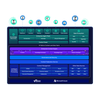
A robust enterprise content management system provides unified repositories, access controls and retention policies that turn scattered content into connected, trusted AI-ready data. Capabilities such as content federation, knowledge enrichment and AI-enabled records management help overcome AI adoption barriers to reduce costs and mitigate risks.
Three key capabilities for AI-ready content management
Content federation unifies access to content across repositories without migration — essential for institutions with multiple vendor ecosystems.
Knowledge enrichment transforms unstructured documents — such as transcripts, forms and correspondence — into tagged, searchable, AI‑ready content.
AI‑enabled records management automates classification, retention, FERPA requirements, lineage tracking and discovery workflows.
That translates into lower costs, a stronger compliance posture for Title IV, FERPA and audit requirements, and reduced staff burden from manual reconciliation and exception handling.
Modernize at the speed of trust and scale responsibly
Effective AI adoption in higher education requires transparency, governance and a measured implementation strategy. According to Deloitte, while many institutions recognize AI’s potential, only 42% of organizations say they are highly prepared for AI adoption, and even fewer report strong readiness around governance and risk management.
Leaders are prioritizing measured approaches that reduce risk, uphold equity and apply AI where it adds value. Choosing a trusted partner is also critical.
Start with low‑risk, high‑volume processes, such as intake, completeness checks and transcript parsing. Apply HITL for policy-driven decisions — such as financial aid eligibility and transfer credits — and maintain explainability, audit trails and data lineage for fairness and compliance.
A pilot-based approach allows institutions to avoid risk in high‑stakes decisions, improve workforce adoption and demonstrate ROI quickly to stakeholders, donors and governing boards. With agentic process orchestration, schools can then scale these capabilities across departments without large-scale system overhauls.
> Read more | Benefits of a low-code solution
How one university reimagined transformation
Indiana State University (ISU) relied heavily on third-party support to modernize campus operations and improve experiences for students and staff. However, this approach often introduced delays rather than efficiencies.
Students’ financial aid data — captured through a legacy forms solution and validated by parents or guardians — existed as static documents, limiting its usability beyond collection. The university needed a scalable solution to automate workflows while integrating with existing infrastructure.
The university selected Hyland Automate™ for its low-code, AI-enhanced, content-driven process automation capabilities. This solution addressed significant challenges related to ISU’s legacy forms approach, including limited functionality and integration gaps with its enterprise content management system.
Hyland Automate has transformed how we manage forms and processes. We’ve seen improvements in efficiency, and it’s only the beginning.
Automate enables users to create dynamic forms with digital signature options. Conditional field displays allow forms to adapt in real time based on user input, enhancing the experience for applicants.
The university modernized form collection and workflows, improving staff productivity and student experiences. ISU also plans to expand the use of Automate to streamline and transform workflows across the institution.
A responsible approach to AI
Colleges and universities have made meaningful progress in digitization — but growing content volume, manual processes and siloed systems continue to impact student experience and productivity.
AI‑enhanced content management and process automation offer a transformative opportunity to automate document-heavy tasks, unify content, improve data quality and accelerate decisions with transparent and explainable workflows.
By adopting a phased, governed and responsible approach to AI, institutions can:
Speed student and staff‑facing processes
Improve accuracy and compliance
Reduce cost‑to‑serve and operational strain
Strengthen agility and growth amid shifting enrollment patterns
Deliver faster, more equitable experiences that support student success
AI agents are already delivering measurable improvements for organizations: more than 40% have realized gains in process efficiency, intelligence and agility, and 60% report improved customer experience outcomes.
Higher education doesn’t need to rip-and-replace existing systems to modernize effectively. It needs AI‑ready content, governed automation and integrated agentic workflows to build trust, deliver measurable impact and scale across departments.
Hyland helps educational institutions modernize at their own pace while maximizing the value of enterprise systems and empowering AI‑assisted transformation.
For more information, explore Hyland’s higher education expertise.

Article
A comprehensive guide to workflow automation
Learn the definition of workflow automation, how to implement it and how it powers increased speed, accuracy and visibility enterprise-wide.

Case Study
Hyland Cloud ROI Case Study
Learn how a private university transformed operations with Hyland Cloud, achieving an annualized 114% ROI and a payback period of just 13.5 months.

Article
What can you do with Hyland IDP?
Hyland's AI-powered intelligent document processing solution brings instant value and efficiency to teams that work with document capture, classification, extraction and validation.

Case Study
Bellevue University accelerates end-to-end automation with Hyland Automate
Bellevue University utilizes Hyland Automate to modernize forms and workflows, reduce manual effort and build a scalable foundation for long-term digital transformation.