Meet the content-powered agentic bank
Learn how AI agents work with intelligent content platforms to automate decisions, accelerate operations and deliver exceptional customer experiences.

Introduction
The modern financial institution faces an uncomfortable paradox. Banks hold vast repositories of valuable data — customer information, transaction histories, regulatory documents, loan files, compliance records, etc. — yet struggle to unlock its potential.
Executives sit in boardrooms surrounded by data but starved for insights. Loan officers waste hours manually reviewing documents. Compliance teams drown in a sea of unstructured content. Customers wait in queues while banks search through digital silos to answer a simple question.
Many financial institutions operate on legacy systems and manual processes that haven’t fundamentally changed in decades. But a transformation is underway, and it’s being driven by organizations that have embraced what we call the content-powered agentic bank. It’s a new model where AI agents work with intelligent content platforms to automate decisions, accelerate operations and deliver exceptional customer experiences.

The problem: Banking’s unstructured data crisis
Let’s start with the stark reality. Unstructured data makes up 80% of enterprise content, and financial institutions are drowning in it. Customer communications, loan documents, regulatory filings, internal memos, email chains, scanned checks and voice recordings are scattered across an average of 21 systems.
Even within a single system, critical information is buried in PDFs, images and free-form text fields. This fragmentation creates a cascade of problems.
Operational inefficiency
Loan officers manually search documents to assess creditworthiness.
Compliance officers manually cross-reference regulatory documents to identify risk.
A customer service representative unable to find complete account history without consulting three different systems.
These aren’t outliers. They’re the daily reality for thousands of financial professionals.
Decision risk
Without rapid access to complete information, decisions suffer.
Banks miss market trends because analysts can’t quickly synthesize data across repositories.
Risk assessments are incomplete because critical documents are overlooked.
Customer intelligence is siloed, preventing a holistic view of client relationships and needs.
Regulatory exposure
In banking, incomplete compliance can be costly:
Missing an audit trail
Overlooking a red flag
Failing to consolidate customer information across systems
These gaps create regulatory risk that keeps compliance and risk leaders awake at night.
Customer frustration
Perhaps most damaging, customers experience delays and disconnected service.
Refinancing requests stall because the bank can’t quickly locate prior correspondence.
Fraud inquiries takes weeks to resolve because information is scattered.
In an industry built on trust and efficiency, these failures are damaging.
The root cause: Traditional approaches to managing information fall short.
Organizations need to extract insights and efficiently use them to drive context-aware actions at scale. Most banks simply don’t have the tools to do this. Until now.
> Learn more: 7 ways to accelerate operations with a content-powered agentic bank
The solution: Content intelligence meets agentic AI
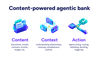
The content-powered agentic bank represents a fundamental reimagining of how financial institutions operate. It combines two powerful forces: intelligent content platforms that structure and enrich unstructured data, and agentic AI that uses this content to make autonomous decisions and drive workflows.
Here’s how it works:
Foundation: Hyland Enterprise Context Engine™
The Enterprise Context Engine transforms your lending and customer onboarding data instantly.
Application documents, financial statements and identity verification records are curated into structured content and linked to relevant customer and risk information — supplying creditworthiness indicators.
Account transaction histories are analyzed to detect relationships between customers, accounts and external parties while validating compliance with know-your-customer (KYC) and anti-money laundering (AML) requirements.
Documentation is organized through the knowledge graph, connecting customers to their accounts, accounts to risk profiles and transactions to compliance frameworks.
The result: Your application packages and customer files aren’t scattered documents; they’re structured, AI-ready assets connected through your business logic.
Intelligence layer: Hyland Knowledge Discovery™
Next, your teams need rapid access to this structured intelligence. Knowledge Discovery — an AI-powered search and decision-support platform — enables grounded, explainable answers to complex business questions across multiple documents and topics.
A financial analyst can ask, “What’s the trend in commercial real estate lending in our portfolio this quarter?” and receive a synthesized answer drawing from multiple sources with cited evidence.
A compliance officer can ask which customer accounts have regulatory flags across all systems and get a consolidated view instantly.
The result: Decisions take minutes instead of days. That’s the power of intelligent content discovery.
Automation layer: Hyland Agent Builder™ and Hyland Automate™
Finally, you can extend this intelligence into autonomous agents. Agent Builder enables you to configure AI agents that specialize in specific business tasks and operate with human supervision, and Automate gives you the power to configure and orchestrate multiagentic workflows or end-to-end processes.
These agents combine the enriched content with business logic to drive decisions.
A loan underwriting agent can review loan applications, extract key financial indicators, identify risk factors and recommend approval or further review —in minutes instead of days.
A compliance agent can monitor customer relationships in real time and flag potential AML concerns by correlating transaction data, customer communications and regulatory patterns.
A customer service agent can instantly provide comprehensive account history, recent transactions and personalized product recommendations by accessing unified customer intelligence.
These aren’t chatbots. They’re specialized business agents operating on your most critical processes.

From Content To Intelligence: A Spotlight On Financial Services
Forrester Consulting study examines AI agent adoption
Today, 60% of financial services organizations are using AI agents. Leaders view this as a long-term shift, with 88% of decision-makers identifying AI agents as central to the next phase of transformation.
This study explores how financial services organizations are scaling AI beyond pilots into real business impact. You’ll find out where AI agents are delivering the most value and learn the key barriers to progress.
Real-world example: Loan operations acceleration
The scenario: A community bank processes mortgage applications in high volumes during peak seasons, with each requiring a loan officer to manually review credit reports, tax returns, employment verification, appraisals and title documents. The process stretches 10-15 business days and invites human error at every step. Quality control analysts compound the timeline by conducting post-close audits to catch missing information or signatures that might have slipped through the cracks.
With a content-powered agentic bank:
The Enterprise Context Engine automatically extracts and structures all required data points.
An underwriting agent performs initial assessment, flagging any missing information or concerns.
An agent synthesizes credit analysis, debt-to-income ratios and comparable property values.
A loan officer receives a consolidated recommendation with supporting evidence.
At the quality control step, the agent automatically locates and reviews loan files, validates required documentation, identifies discrepancies and routes exceptions to humans with a clear audit trail.
The impact: Processing times drop to two or three days. Post-close quality control can review more loan packets, improving productivity and reducing risk.

The next wave of intelligent automation for banks
Find out where agentic AI is delivering the most value
An American Banker survey found that 73% of bank and credit union workers are in some stage of intelligent automation, and 68% expect agentic AI to be at least moderately transformative for their automation efforts.
This report explores the value financial institutions are receiving from these initiatives and how early wins are laying the groundwork for continued advancements. You’ll also learn why finding the right technology partner is critical.
Why Hyland: Purpose-built for financial services
Many vendors talk about AI and automation, but few understand financial services. Hyland is different.
Hyland’s content intelligence and automation products — Enterprise Context Engine, Knowledge Discovery and Agent Builder — are built for the complexity of financial institutions. The platform handles the reality of banking: multiple legacy systems, heavily regulated processes and the need for complete audit trails.
Proven scale: Hyland is trusted by thousands of organizations, with proven technology handling billions of documents and transactions daily.
Purpose-built intelligence: Our enrichment technology handles more than 600 file formats and understands financial documents while preserving context to extract actionable intelligence.
Comprehensive platform: Unlike single-capability vendors, Hyland’s integrated platform combines content structuring, intelligent discovery and agentic automation to reduce complexity and accelerate implementation.
Governance and compliance: Our platform maintains full traceability and comprehensive logging to support auditable, compliant operations that secures sensitive financial data.
Human-in-the-loop automation: Agent Builder and Automate enable multiagent collaboration to automate complex workflows while maintaining appropriate human oversight for regulated environments.
Transform your content into a strategic advantage
The competitive advantage is clear. The banks that win in the next five years will be those that have transformed content from an operational and compliance burden into a strategic advantage.
They’ll have AI agents that work alongside their teams, augmenting human judgment rather than replacing it. They’ll transform content into intelligence to deliver personalized, effortless service.
Ready to transform your financial institution? Contact us today or schedule a demo to see the content-powered agentic bank in action.

Article
Why financial services firms should take a three-pronged approach to innovation
Explore how modernization, automation and AI can put financial institutions on a path to success.

Case Study
How FGA is modernizing high-volume credit guarantee processes with agentic automation
FGA, a Colombian financial services organization, is implementing agentic automation with Hyland Content Innovation Cloud™ to streamline critical credit guarantee processes, accelerate response times and support continued growth.

Article
Revolutionizing financial services: The impact of artificial intelligence
AI is transforming the banking industry. Explore key impact areas, use cases, the power of content intelligence and indicators of AI-readiness.

Case Study
American National Bank of Texas
Future-ready bank deploys Hyland OnBase in the cloud to automate business processes, securely manage documents and empower employees.