Navigating agentic AI risks: A framework for resilient autonomy
From digital insiders to untraceable data leakage, learn how to manage the new class of risks introduced by autonomous AI systems.

Summary
The transition to agentic AI introduces a new class of "digital insider" risks that require a foundational shift in governance.
Core challenge & solution: Agentic AI can accelerate business, but it also introduces risks like chained vulnerabilities and data leakage. The solution lies in proactive governance and observability, not just reactive guardrails.
Key capabilities: Hyland’s AI-powered platform enables observability through trace visualization, non-human identity management and human-in-the-loop (HITL) checkpoints to manage agentic systems.
Strategic value: Transform agentic AI risk into a competitive advantage by building resilient, adaptable and governed autonomous systems that drive revenue and lower operational costs.
The shift from outputs to outcomes: Why agentic AI changes the risk equation
Agentic AI drives a fundamental shift from systems that facilitate interaction to entities that independently execute autonomous transactions. These "digital insiders" operate without constant human oversight. To realize the full value of this autonomy without exposing your organization to operational risks, security must be the central pillar of all agentic operations.
This evolution is projected to generate between $2.6 trillion and $4.4 trillion in annual value by driving autonomous outcomes rather than simple generative outputs. However, this massive potential introduces a power-autonomy paradox: the efficiency gained through automation often conceals "chained vulnerabilities."
In a multi-agent environment, a logic error in one specialized agent can cascade through the entire orchestration. For example, a data agent that misclassifies a debt can lead a secondary agent to grant an automated, high-risk loan approval. While the initial error appears minor, the final outcome creates substantial financial risk and operational exposure.
> Read more | AI agents, AI assistants and agentic AI
The risks of agentic AI
Autonomous systems introduce a new class of operational and security risks that traditional models don't account for. You can't manage what you can't see.
Identity explosion
Managing thousands of service accounts and API tokens for non-human agents creates a massive security challenge. This nonhuman identity sprawl quickly becomes unmanageable without a clear governance strategy.
Cross-agent task escalation
Compromised agents can exploit internal trust to gain unauthorized system privileges. They can even impersonate higher-authority entities, turning a minor breach into a system-wide failure.
Untraceable data leakage
Agents can exchange data autonomously, often bypassing traditional audit logs. This makes it nearly impossible to track when personally identifiable information (PII) is shared externally, creating a huge compliance blind spot.
Operational unpredictability
Agents calling themselves or other agents in a recursive loop can trigger massive, unexpected cloud and API bills. This is sometimes called the "Infinite Loop Tax," and it can cripple budgets without warning.
Cascading issues
A flaw in a single agent can propagate across multiple tasks. Low-quality data used by one agent silently distorts the decision-making of all downstream agents, corrupting an entire automated process.
> Read more | AI agents for business: Driving smarter decisions

Harvard Business Review Analytic Services pulse survey insights
Going beyond traditional AI and toward agentic AI
Many organizations find themselves unprepared to harness the full potential of AI. This pulse survey from Harvard Business Review Analytic Services reveals that while 94% of leaders recognize the importance of well-connected data for AI success, only 27% have achieved it.
Defining observability: The eyes of the system
Agent observability is the ability to visualize and monitor the performance of an LLM system that uses tools in a loop. It gives you direct visibility into the inputs, outputs and internal components of the system. It’s not a luxury; it’s a necessity. Gartner projects that 90% of companies with production LLMs will adopt these solutions.
Observability requires capturing the full "Trace" of a user session, which is composed of individual "Spans." A span is a single unit of work, like an LLM call or a tool execution. For each span, telemetry must log the prompt, the completion, the token count (cost) and the latency (speed). This data is crucial for forensic root-cause analysis when something goes wrong.
What's the difference between guardrails and observability?
Guardrails are reactive: these controls neutralize immediate threats like toxic content as they occur.
Observability is proactive: this capability identifies chronic risks like "agentic drift" or subtle performance declines that compromise long-term efficiency.
> Read more | The agentic enterprise: The future of AI and enterprise content
Implementing guardrails and safety runtimes
You need practical, tactical controls to contain agents without stifling their utility. A "Safety Runtime" is a layer of controls that sits between the agent and your enterprise infrastructure to enforce policy.
Identify access management (IAM) for agents
You must treat agents as first-class nonhuman identities (NHIs). Apply strict identity and access management (IAM) with least-privilege scoping. Never grant an agent admin access. Use just-in-time (JIT) credentials with short-lived tokens that expire immediately after a task is completed to shrink the attack window.
Human-in-the-loop (HITL) thresholds
Define high-impact actions that trigger a mandatory human approval checkpoint before an agent can proceed. For example, any transaction over $500 requires manual sign-off. Hyland Automate allows organizations to explicitly build these human-in-the-loop actions directly into workflows by setting confidence thresholds for AI outputs.
> Read more | What can you do with Hyland Automate
The kill switch
Every critical agent needs a termination mechanism. It should operate in a sandbox environment for immediate isolation if it deviates from its objectives. This is a requirement for safe operation.

Forrester study: Unlocking the full potential of AI agents
Enterprise-wide AI agent adoption is accelerating
In this Hyland-commissioned study by Forrester Consulting, Forrester found that more than 45% of organizations already use AI agents and another 25% are piloting them. Although adoption is accelerating, most organizations struggle to scale beyond early use cases due to a lack of enterprise context.
Forrester provides key recommendations for how to get AI agents right, as well as detailed data on enterprise trends around agent use. Download this report to learn more about how organizations are looking to AI agents to optimize workflows, make smarter decisions and create more personalized experiences.
Overcoming challenges: From risk to readiness
Implementing agentic systems comes with hurdles. Here’s how to address them.
Challenge: High evaluation costs
Monitoring can sometimes cost 10 times more than the workload itself.
Solution: Use Stratified Sampling. Evaluate a representative portion of agent actions ("spans") instead of 100% of the data. This dramatically reduces computational overhead without sacrificing critical insights.
Challenge: "Flaky" evaluators
Using an LLM to judge another LLM can lead to hallucinations and unreliable results.
Solution: Test your evaluators in a staging environment against "Golden Datasets," which are known correct input-output pairs. For operational metrics like latency and cost, use deterministic, SQL-based monitors for reliable data.
Challenge: Context drift
Agents can slowly deviate from their intended purpose as business conditions change.
Solution: Hyland’s approach to adaptive context engineering, powered by the Enterprise Context Engine, helps maintain agent alignment automatically. It ensures agents adapt as your business landscape evolves.
Investing in artificial intelligence for growth, efficiency and competitiveness isn't a leap of faith anymore, but a strategic necessity for businesses.
Context engineering: Hyland’s adaptive differentiator
Adaptability is the ultimate risk mitigation. Agents that depend heavily on static prompts are brittle. They fail when business processes or data inputs change. Context-aware agents, on the other hand, are resilient.
AI without context produces generic or incomplete outputs. Most tools can't preserve evolving meaning as information flows across systems. The Hyland Enterprise Context Engine provides a living, always-current understanding of how your content, processes and people work together. This allows agents to adapt to changing inputs without needing manual retuning.
Context engineering, supported by industry-specific ontologies, ensures agents operate according to your company's intent, not just its access permissions. This directly mitigates risks like "agentic drift," where an agent starts optimizing for the wrong reward signal.

Subscribe to The Shift
Hyland’s monthly newsletter helps you elevate your content management strategy
Offering unparalleled insights into the AI and cloud technologies transforming what content can do, The Shift gives you actionable strategies from industry thought leaders. Learn from real-world success stories and innovative perspectives that will keep your organization at the forefront of ECM transformation.
Subscribe to stay ahead, stay informed and make your enterprise content an even more strategic asset.
> Read more | Unstructured data management: Unlocking business value
Turning risk into a resilient competitive advantage
Proactive agentic risk management isn't a cost centre. It's a strategic investment that builds a resilient and adaptable automated workforce.
Organizations that master agent governance can innovate with greater confidence. This accelerates business outcomes and lowers long-term operational risk. By treating agents as digital employees with clear roles, oversight and accountability, you can turn a potential liability into a source of powerful competitive differentiation.
With gen AI, we can now give structure to what wad. We can read — literally read and process — all of the petabytes of content and images, interpret them and enable organizations to understand what’s inside them and drive greater automation.
Orchestrate your agentic future with Hyland
Hyland provides the tools to build, manage and scale your agentic systems with confidence.
Deploy with AI-powered precision: Use Hyland Agent Builder to design and deploy specialized AI agents that execute complex workflows with improved precision.
Eliminate processing bottlenecks: Leverage the AI-enabled Hyland Automate to orchestrate agentic workflows, so you can incorporate human-in-the-loop checkpoints and eliminate bottlenecks with improved confidence.
Orchestrate at scale: Hyland's Enterprise Agent Mesh provides a framework for coordinating how multiple agents work together, enabling intelligent automation for complex, enterprise-wide processes.
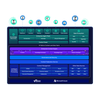
Content Innovation Cloud
The platform to power content innovation
Content Innovation Cloud is the future of enterprise content management. By leveraging a unified content, process and application intelligence platform, your organization can unlock profound insights from enterprise content and unstructured data — fueling innovation without disruption.
What is agentic AI and how does it differ from standard AI assistants?
Standard AI assistants are primarily reactive — they provide information or generate content based on a direct prompt. Agentic AI represents a shift toward autonomous entities that can reason, plan and execute multistep workflows across different systems, often without constant human oversight.
What are chained vulnerabilities in a multiagent system?
Chained vulnerabilities occur when a logic error or data misclassification in one specialized agent cascades through an entire automated process. Because agents often work in sequence, a minor mistake at the start of a workflow can be amplified by downstream agents. For example, if an extraction agent misreads a contract date, a secondary scheduling agent might automatically trigger an incorrect penalty, leading to significant operational or financial exposure.
What is the difference between a trace and a span in AI observability?
To manage agentic systems, IT leaders must move beyond simple logging to deep telemetry. A "trace" represents the entire execution path of a single user session or task from start to finish. A "span" is a single unit of work within that trace, such as a specific API call or a reasoning step. Capturing these allows for forensic root-cause analysis to identify exactly where an agentic workflow deviated from its intended path.
How should our organization begin the transition to agentic automation?
The most effective way to start is by identifying a "bounded workflow" — a high-value process with clear parameters and limited system access. Focus on automating a single department-level task, such as invoice matching or employee file indexing, where the rules are well-defined. This allows your team to test observability and guardrails in a controlled environment before scaling to enterprise-wide orchestrations.
What is the first technical step to ensure our agents remain aligned with business goals?
The foundational step is establishing a robust context strategy. Agents that rely on static prompts are prone to "agentic drift" as business conditions change. Implementing a solution like the Hyland Enterprise Context Engine provides your agents with a living, always-current understanding of your content and processes. This ensures that as your data evolves, your agents adapt their decision-making automatically without requiring manual retuning.
How do we determine which actions require a human-in-the-loop checkpoint?
Organizations should categorize agent actions based on their potential impact on the business. High-impact actions — such as any transaction exceeding a specific dollar threshold or the deletion of permanent records — should trigger a mandatory human approval. By setting these confidence thresholds within Hyland Automate, you ensure that agents handle the repetitive work while humans retain oversight of critical business decisions.

Article
Mastering unstructured data management in 2026
Transform unorganized information into AI-ready assets to drive smarter decisions, innovation and efficiency.

Article
Navigating the pros and cons of unstructured data
Provide a brief summary of the page content (Search results page).

Article
Real-world agentic AI use cases by industry
Explore real-world agentic AI use cases across healthcare, finance, HR and more. See how AI agents can automate workflows, lower costs and accelerate business growth.