
Summary
The synergy of Robotic Process Automation (RPA) and Artificial Intelligence (AI) is the foundation of Intelligent Process Automation (IPA), transforming manual tasks into streamlined, end-to-end digital workflows.
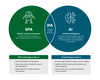
RPA: Software bots that execute repetitive, rules-based tasks using structured data, such as data entry, form filling, and record updates.
AI: Advanced systems that mimic human intelligence to analyze unstructured data, recognize patterns, and make complex decisions that improve over time.
IPA: The integration of RPA and AI to manage entire business processes, allowing organizations to automate complete cycles of work with minimal human intervention.
Use cases
Customer Service: RPA automates refund transactions and scheduling, while AI-powered chatbots triage inquiries and provide personalized responses.
Financial Services: RPA handles invoice downloading, while AI-powered Hyland IDP handles processing.
Healthcare: RPA manages patient record storage and appointment reminders, while AI assists in diagnostic accuracy by identifying irregularities in medical imaging.
How RPA and AI drive end-to-end intelligent process automation
The combination of RPA and AI in intelligent process automation transforms the way organizations operate by enhancing efficiency, improving decision-making and streamlining processes.
Intelligent process automation (IPA) has become a cornerstone of efficiency and innovation. Robotic process automation (RPA) and artificial intelligence (AI) stand at the forefront of this transition, providing organizations a combination capable of revolutionizing the way operations are carried out.
We delve into the difference between RPA and AI, its common uses, how they interact and the best way to prepare your organization to leverage both technologies in an IPA strategy.
The difference between RPA and AI
The difference between RPA and AI is that RPA automates repetitive tasks based on fixed rules and inputs, while AI is capable of doing much more.
RPA is a technology that utilizes software robots (sometimes simply called bots) to carry out routine tasks. RPA operates within the confines of preprogrammed business rules, making it adept at managing structured tasks and adhering to a set of predefined prompts.
For instance, RPA could be employed to automate routine tasks such as data entry or invoice processing, performing the tasks much quicker and without error.
AI, on the other hand, is a broader concept referring to machines or software that exhibit capabilities that mimic or simulate human intelligence. For example, customer service chatbots can leverage natural language processing (NLP) and large language models (LLMs) to understand context and respond to customer inquiries with a high degree of relevance and personalization.
Think of AI as the decision maker, and RPA as one of the tools it may use to complete the job.
While RPA automates repetitive tasks without the need for human intervention, AI simulates human intelligence and decision-making.
How RPA and AI interact
Although distinct in their capabilities, RPA and AI often work in tandem to complement each other's strengths.
Here’s how they work side by side if a customer at a bank wants to open an account:
RPA processes:
Customer verification: RPA can automate the verification process by cross-referencing customer details such as credit scores against established databases, significantly speeding up this step.
Form filling: RPA software can automatically fill out necessary forms using customer-provided information, reducing the chance for human error.
Account creation: Once customer details are verified, RPA can initiate the account creation process without needing human intervention.
AI processes:
Automated compliance checks: AI can ensure compliance with banking regulations, reducing the risk of noncompliance penalties.
Customer service chatbots: Based on their queries, AI-powered chatbots guide customers in completing the form relevant to the type of solution or product a customer is interested in.
Fraud detection: AI systems can identify unusual patterns that might indicate fraudulent attempts.
> Explore the market | The rise of intelligent process automation (IPA)
The rise of intelligent process automation (IPA)
According to Grand View Research, the global intelligent document processing market is projected to reach a staggering $11.29 billion by 2030, underscoring the rapid adoption of intelligent processing automation (IPA) technologies across industries.
IPA combines technologies such as RPA, AI, large language models (LLMs) and systems integration Unlike traditional automation, IPA can hard-coded with business logic and can adapt to changing contexts.
It’s a combination that offers an integrated approach to automation, capable of executing tasks, adapting to new context or data patterns and driving informed decisions — streamlining end-to-end business and IT processes across functions. This accelerates task execution to shorten business cycles, reduce handoffs and deliver measurable ROI.
> Learn more | How to drive more value from automation with intelligent capture
Benefits of intelligent process automation
Here are more benefits to leveraging RPA and AI for end-to-end IPA:
Streamlined operations
RPA drives efficiency throughout repeatable tasks but may struggle when it comes to managing unstructured data. AI uses human-like reasoning to complete more complex tasks by being more aware of context and various exceptions.
In document processing, AI technology may employ techniques such as text recognition, entity extraction and other NLP capabilities to make sense of the content. This ensures the system becomes context-aware, understanding not just the information but also the nuances and relationships within the data.
Greater insights into data
The combination of RPA and AI enables a more comprehensive and holistic view of customer data. RPA can integrate data from various sources, ensuring a unified customer profile. After that, AI algorithms can analyze this data to identify patterns and provide more valuable insights.
For example, an AI system might recognize that certain customer segments prefer online shopping during specific times or respond positively to particular promotions. These insights go beyond what traditional analytics might offer, as AI can discern complex relationships within the data.
Cost efficiency
AI-driven automation also lowers your operational cost and risk by eliminating repetitive data work — reducing errors, improving governance and lowering cost per transaction. Findings from a Deloitte report suggest that organizations currently scaling intelligent automation say they have already achieved a 27% reduction in costs on average from their implementations to date.
In the healthcare sector, RPA can automate the claims processing system, ensuring that billing and payments are error-free and timely while AI can be used to detect fraudulent claims. The outcome is a reduction in costs, as both administrative efficiency and fraud prevention are maximized.
Increased compliance
RPA and AI together bolster compliance efforts by ensuring strict adherence to protocols and thus, reducing risks.
In financial institutions, RPA is used to automate anti-money laundering checks while AI continuously monitors transactional data for suspicious activity. This collaboration ensures strict adherence to regulations and safeguards both the reputation and financial stability of the institution.

Watch the webinar: Navigating the Adoption of Intelligent Automation and AI
Curious about how intelligent automation and AI can transform your organization?
Hear from industry experts from Hyland and Deep Analysis as they cover key findings from the recent Deep Analysis: Market Momentum Index report. Learn the current trends, actionable strategies and best practices to overcome challenges like data quality and process optimization.
9 common uses for RPA and AI
Here are nine common use cases where RPA and AI work in unison to reshape how organizations operate, as well as the end benefits your customers can see.
1. Customer service
RPA bots can easily scale to handle an increased volume of customer service tasks without the need for additional hiring. This comes in handy when dealing with sudden spikes in customer inquiries, ensuring that the service remains efficient and responsive. These include:
Extracting relevant information from invoices, updating financial records and automating the reconciliation process
Streamlining the refund process by automating the validation of refund requests, updating financial records and initiating the refund transactions
Automating appointment scheduling processes — which includes checking availability, sending confirmation emails and updating calendars
AI comes in to “triage” ticket creation and routing. AI algorithms can analyze the content of customer queries, categorize them and prioritize based on urgency or complexity.
2. Financial institutions
RPA can automate repetitive accounting processes like processing invoices, while AI can spot cost-saving opportunities and significant financial risks. By maximizing both financial efficiency and accuracy, this combination lowers the likelihood of human error and promotes accurate financial reporting.
RPA and AI can also synergize to transform mortgage applications processing and know your customer (KYC) procedures. RPA starts with automating repetitive tasks such as data entry and document verification, while AI — leveraging NLP and ML — enhances KYC procedures by automating identity verification and risk assessment, learning from historical data to detect potential risks or fraud.
> Read more | Modernization, automation and AI in financial services
3. Risk and compliance management
RPA and AI are essential to risk management and compliance because they guarantee risk assessments, compliance checks and other crucial protocols are never mishandled.
In the healthcare industry, RPA can automate the processing of insurance claims while AI detects irregularities or fraudulent claims. As a result of this cooperation, the chances of fraud and regulatory fines are lowered due to the detailed risk assessments and compliance checks being made.
4. Inventory management
RPA bots can automatically reconcile received goods with purchase orders, update inventory databases and generate reports.
Predictive analytics, a subset of AI, could then use historical data to forecast demand more accurately. AI algorithms can analyze patterns in purchasing behavior, season preferences and other external factors to predict future inventory needs, so your business can reduce excess inventory costs and optimize stock levels.
5. Employee onboarding
While AI can help match job candidates to relevant roles, RPA can handle repetitive HR-related onboarding duties like entering new employee data into systems.
RPA and AI integration also allows for the creation of dynamic onboarding workflows. AI can then assess the individual needs and preferences of new employees, while RPA automates the execution of personalized onboarding plans, adapting the process based on real-time feedback and evolving employee requirements.
6. Marketing campaign optimization
LLMs can be employed to analyze textual data, such as customer reviews or social media comments, providing a more nuanced understanding of sentiment and preferences. RPA can then integrate with customer relationship management (CRM) systems and email marketing platforms to help trigger personalized email campaigns.
The synergy between AI and RPA is in their complementary roles. While AI analyzes and interprets intricate consumer data to inform targeted marketing strategies, RPA automates the execution of these strategies, ensuring personalized content is delivered efficiently and in real-time.
7. Healthcare
Setting up and managing appointments in healthcare takes a lot of time. But with AI and RPA application, patients can easily book appointments and get personalized messages to confirm, change or update their records.
At the same time, RPA automates the retrieval and storage of patient data, whereas AI helps improve healthcare diagnostics by being able to spot irregularities in medical imaging like X-rays or MRI scans. This combination helps eliminate diagnostic errors, expedite patient care and ultimately improve healthcare outcomes.
8. E-commerce recommendations
AI actively observes and analyzes customer interactions with products, utilizing algorithms to understand consumer behavior and preferences.
RPA can automatically send tailored product recommendations via email or within an online platform. Both AI and RPA in the retail space result in a win-win situation: Customers benefit from a more tailored and satisfying shopping experience, and organizations can use the data to drive more purchases as a result of strategically targeted recommendations.
9. Smart maintenance
In industries with heavy machinery or infrastructure, AI can predict when equipment might fail; RPA can automatically schedule maintenance or order replacement parts.
AI analyzes numerous data inputs, such as usage patterns, to forecast maintenance needs while RPA complements this by automating the process of scheduling maintenance and ordering replacement parts. This collaboration minimizes downtime, reduces maintenance costs and ensures the continuous operation of critical machinery.
> Read the case study | How this fashion company saves more than 8 hours per day in manual labor with RPA
Preparing your business for RPA and AI integration
Here's a step-by-step guide to ensure a smooth integration:
1. Conduct an assessment: Evaluate your current processes to determine how automation can benefit your business.
2. Prioritize core processes: Identify where RPA suffices and where AI can add value. Focus on processes that are mission-critical and have a high impact on customer satisfaction.
3. Invest in training: Equip your workforce with the knowledge to work alongside AI and RPA systems. This should include training on the specific RPA and AI tools selected, as well as general awareness of how these technologies will enhance their work processes.
4. Assess existing infrastructure: Ensure your IT infrastructure can support these technologies. Consider factors such as data accessibility, system compatibility and security measures.
5. Begin trial runs: Start small by implementing pilot projects or trial runs for RPA and AI integration. This should happen so users are able to test the selected tools, identify potential challenges and collect necessary data before a full-scale implementation.
6. Integrate feedback: Gather feedback from employees involved in the trial runs, as well as other stakeholders.
7. Refine context: AI's power lies in its ability to operate within the constraints of predetermined context and institutional knowledge . Ensure the AI systems have access to relevant, accurate business data to ensure that they provide relevant and accurate results.
8. Establish regular monitoring: Implement monitoring mechanisms to assess the performance of integrated RPA and AI solutions. Regularly review key performance indicators (KPIs) related to employee productivity, accuracy and overall process improvement.
9. Stay updated: Regularly assess the relevance of your integrated solutions and be open to adopting new features or tools that can further enhance the capabilities of your automation initiatives.

Keep up with the rise of intelligent automation
Organizations championing end-to-end intelligent automation can meet — and exceed — evolving customer expectations. When most of the manual “legwork” is automated across functions and teams, your human workforce gets to focus on the bigger picture.
Discover how Hyland’s intelligent automation technology fuels your plans for digital transformation, so more meaningful work gets done at both customer and employee levels.